
Key takeaways
- Biotech marketing changes with your stage. Before a product, you are selling credibility to investors, partners and talent. Later, you are selling a product to users and buyers.
- Platform companies should lead with one or two problems they solve best, not with the platform itself.
- Your evidence roadmap, from papers to posters to case studies, is also your content roadmap.
- In the US, FDA rules prohibit promoting an investigational drug as safe or effective before approval, so agree a claims framework early.
To market a biotech company well, start with a clear, consistent story of what you do and why it matters, then match your audiences, evidence and channels to your stage. Before you have a product, marketing builds credibility with investors, partners and future hires. Once you have something to sell, it shifts to reaching early adopters, proving results and building a predictable pipeline.
Most biotech companies do not have a marketing problem in their first years. They have a clarity problem. The science is strong, but the story changes depending on who is telling it. This guide covers how to fix that and how to grow your marketing as the company grows.
Why biotech marketing is different
Biotech sits at the hard end of B2B marketing. Your buyers and partners are often scientists who read methods sections. Your technology may take years to reach the market. Your claims can be regulated before you have anything to sell. And your audiences change dramatically as you move from discovery to commercialization.
That means generic B2B playbooks often miss. High-volume content, aggressive lead capture and catchy slogans rarely work on expert readers. What works is clarity, credibility and evidence, delivered consistently.
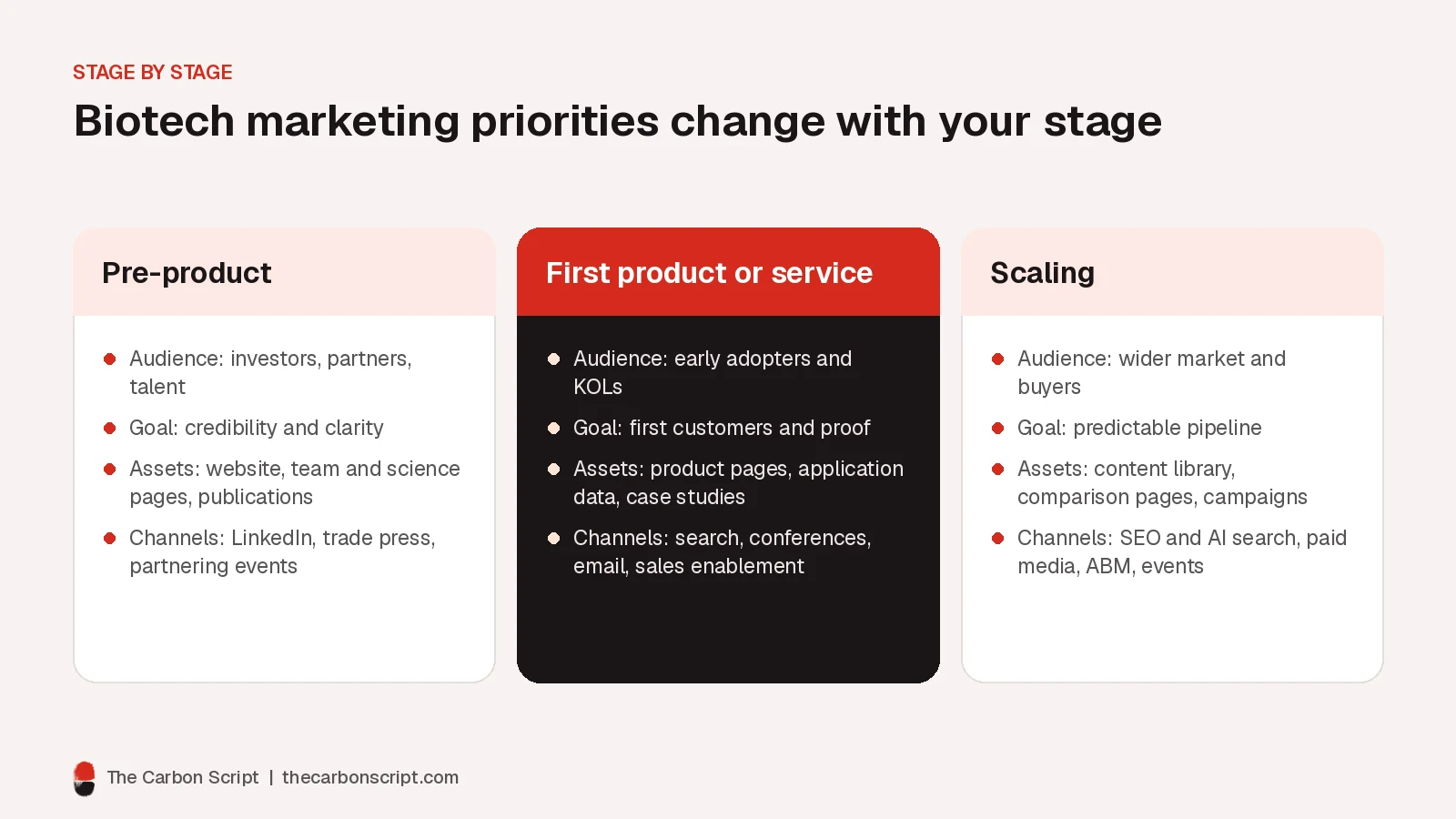
Stage one: pre-product and platform companies
Before you have a product to sell, your audiences are investors, pharma and academic partners, potential hires and the wider scientific community. What they need from you is confidence: that the science is real, the team is credible and the opportunity is large.
At this stage, focus on three things:
- A clear, consistent description of what you do, used by everyone in the company.
- A website that looks like a serious company, with your science, team, publications and news easy to find.
- Steady visibility on LinkedIn and in trade press, so people who hear your name at a conference can quickly check you out.
How to position a platform
Platform biotechs face a specific trap. Because the platform can do many things, the messaging tries to say all of them and ends up saying nothing memorable. Instead, lead with one or two problems the platform solves best, describe the mechanism in one plain sentence, and show proof for those specific uses. You can broaden the story once those footholds are established. Our guide to positioning a biotech company walks through a simple framework.
Marketing to investors
Investor marketing is not a pitch deck alone. Investors check your website, your founders' LinkedIn profiles, your publications and your press coverage. Make sure all of them tell the same story, explain the problem in terms a generalist investor understands, and make the evidence easy to verify.
Stage two: your first product or service
Once you have something to sell, the audience shifts to early adopters: the scientists, clinicians or lab leaders willing to try something new. They want detail. Product and application pages, technical specifications, validation data and honest comparisons with the current standard matter more than polish.
Key opinion leaders and early customers become your most valuable marketing asset. Their data, quotes and conference talks carry more weight than anything you say about yourself, so build case studies and co-presented work into your launch plan from the start.
Your launch checklist
- Product and application pages with specifications, data and documentation.
- A clear next step for each type of visitor: demo, sample, quote or a call with a scientist.
- Launch content: a plain-language explainer, an application note and a short video.
- Sales enablement: a one-pager, a deck and answers to the ten questions sales hears most.
- A plan for the first three case studies, including who, when and what data.
Stage three: building a scalable marketing engine
As you grow, marketing has to generate demand reliably rather than through founder networks alone. This is where SEO and AI search, paid media, email nurturing and account-based marketing come in. It is also when brand consistency becomes critical, because more people are telling your story.
At this stage, build a content library that answers buyer questions at every point in the journey, from "how does this method work?" to "how do you compare with the alternatives?" to "what does implementation look like?".
Turn your evidence into content
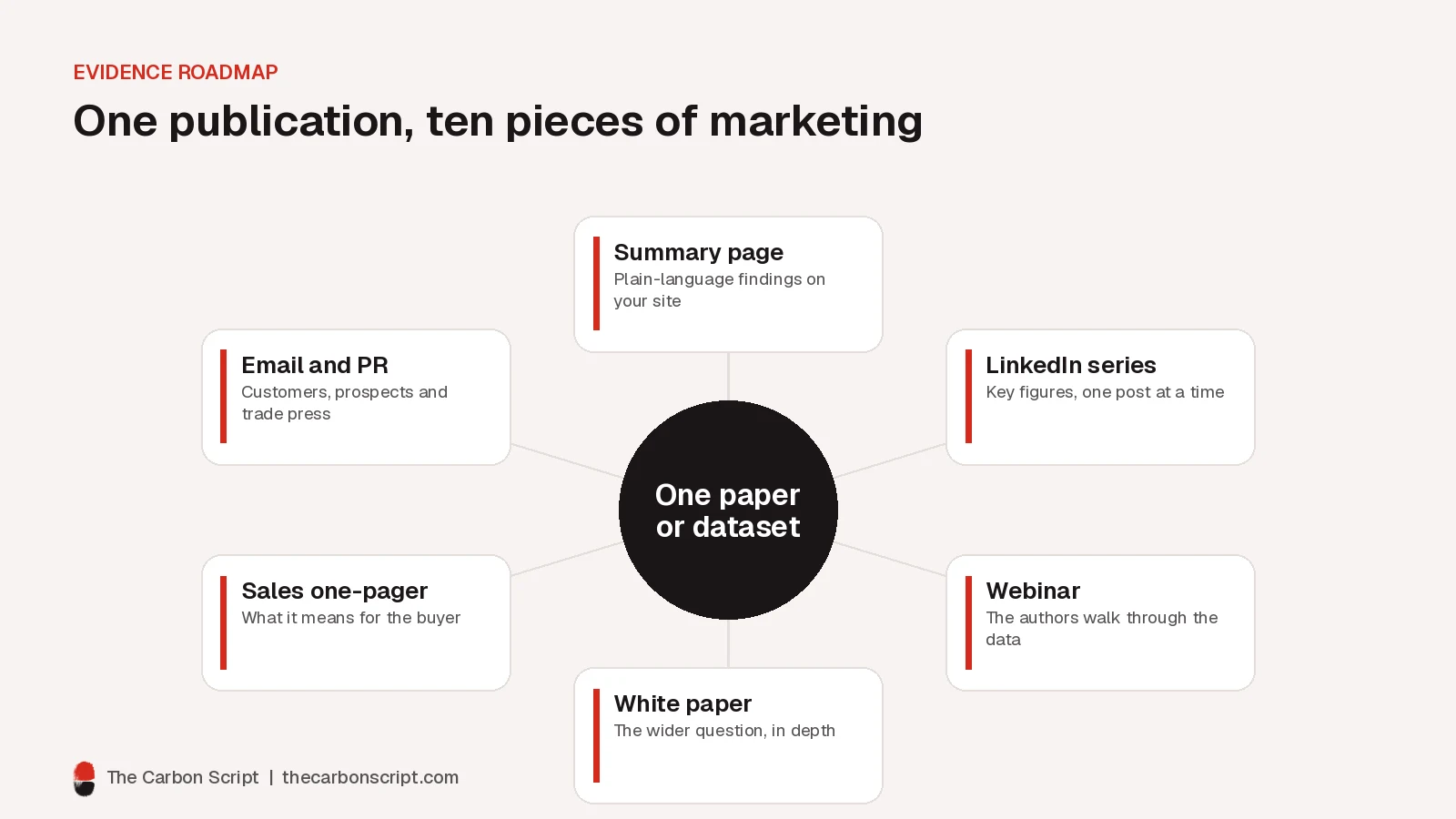
Every paper, poster, preprint and dataset you produce is raw material for marketing. A single publication can become a plain-language summary page, a LinkedIn series, a webinar with the authors, a white paper on the wider question and a sales one-pager. Plan your scientific communication calendar and your marketing calendar together, and you will rarely run short of credible content. Our guide to life science content marketing covers the workflow in detail.
The biotech marketing channels that work
Your website
The hub every other channel points to. It should explain what you do in one sentence, offer separate paths for scientists, partners and investors, and make your publications and data easy to find.
Where scientists, partners, investors and buyers spend professional time. Posts from founders and scientists usually travel further than company page posts. See our LinkedIn playbook.
Conferences
Events such as the BIO International Convention and the scientific society meetings in your field remain central for partnering and visibility. Plan content before, during and after each event, not just a booth.
Trade press and podcasts
Specialist publications and podcasts build third-party credibility. Contribute expert articles and offer your scientists as commentators on topics where they genuinely have something to add.
Search and AI search
Buyers and partners research methods, suppliers and technologies on Google and increasingly in AI tools. Our guide to SEO for biotech companies explains how to be found.
Biotech branding: more than a logo
A biotech brand is the combination of what you say, how you say it and how it looks. The visual identity matters, especially for investor confidence, but the verbal identity matters more: a clear positioning statement, consistent messaging for each audience and a recognizable voice. Brands that look advanced but explain nothing tend to blend into the crowd.
Staying compliant
If you develop therapeutics, be careful about how you talk about investigational products. In the US, FDA regulations (21 CFR 312.7) prohibit promoting an investigational drug as safe or effective for the purposes under investigation before approval. In the UK, the ABPI Code of Practice sets rules for the promotion of prescription medicines. Diagnostics, devices and research-use-only products have their own rules. Agree your claims framework with regulatory and legal colleagues early, so marketing can move quickly within it.
How to measure biotech marketing
- Pre-product: website visits from target organizations, inbound partnering conversations, investor and candidate interest, media coverage.
- Launch: demo, sample and quote requests, conversion rate on product pages, first case studies secured.
- Scaling: qualified leads, pipeline influenced by marketing, win rates and cost per qualified opportunity.
Avoid treating follower counts and impressions as success on their own. They are useful signals, not outcomes.
In-house, agency or fractional?
Many biotech companies start with an agency or fractional support to set positioning and build core assets, then hire in-house once there is a steady commercial workload. A hybrid of one internal lead plus a specialist biotech marketing agency is common at the scaling stage.
How the approach differs by type of biotech
Therapeutics developers
Marketing focuses on investors, pharma partners, patient advocacy groups and future hires rather than buyers. The priorities are a clear scientific narrative, a pipeline page that explains each program in plain language, publication and conference visibility, and careful compliance around investigational products.
Research tools and reagents
Here marketing generates demand directly. Detailed product and application pages, protocols, application notes, comparison content and search visibility do most of the work, supported by sample programs and webinars.
Diagnostics
Diagnostics companies sell to laboratories and clinicians, often with reimbursement and regulatory considerations. Evidence summaries, clear intended-use statements and content for both lab directors and clinical decision makers matter most.
Synthetic biology and platforms
The challenge is explaining a broad capability simply. Lead with two or three concrete applications, show proof for each and keep the platform story as the reason you can do them better.
A 90-day biotech marketing plan
- Days 1 to 30: agree positioning and messaging, audit the website and evidence, and interview customers or partners.
- Days 31 to 60: rewrite the most important website pages, publish two cornerstone pieces from your own data and set up analytics and Search Console.
- Days 61 to 90: launch a LinkedIn rhythm for the company and founders, plan the next conference, and start one focused campaign with a clear offer.
By the end of the quarter you should have one clear story, a website that tells it and a steady stream of content to build on.
Frequently asked questions
When should a biotech startup start marketing?
Earlier than most do. A clear story and a credible website help with fundraising, partnering and hiring long before there is a product to sell.
What is the best marketing channel for biotech?
There is no single best channel. For most companies the combination of a strong website, LinkedIn, conferences and search delivers the most, supported by paid media during launches.
How do you market a biotech platform?
Lead with one or two specific problems the platform solves best, explain the mechanism in one plain sentence, and show proof for those uses before broadening the story.
Can a biotech company market an investigational drug?
Companies can share scientific information about their research, but in the US they cannot promote an investigational drug as safe or effective for its investigational use before approval. Work with regulatory and legal colleagues on any external communication.
Should a biotech company hire in-house marketing or an agency?
Many start with an agency or fractional support, then hire in-house as the workload grows. The right answer depends on stage, budget and how much specialist expertise you need quickly.
Want help putting this into practice?
We're a scientist-led marketing team for life science and technical companies. Tell us what you're working on and we'll show you where to start.
Book a call

