
Key takeaways
- You need scientific depth and commercial marketing skill in the same team. Either one alone usually disappoints.
- Ask who will actually do the work, and whether they can read your papers.
- An integrated team keeps your website, content, SEO and campaigns telling one story.
- The best sign of fit is a clear process for getting your scientists' input quickly and accurately.
To choose a life science marketing agency, look for scientific depth in the people who will do the work, relevant experience with buyers like yours, proven commercial results, a clear process for expert review and regulated claims, and reporting tied to pipeline. Shortlist three agencies, score them against the same criteria, ask the same questions, and start with a defined project before committing to a long contract.
Choosing an agency is one of the more important decisions a science company makes. The right partner can make your company sound as strong as your science. The wrong one can cost months, budget and your technical team's patience. This guide explains how to choose well.
Specialist or generalist agency?
Generalist agencies can be excellent at marketing, but they often struggle with the science. The result is content that is either inaccurate or so vague it says nothing, and long review cycles while your experts fix it. A specialist life science marketing agency should understand your field well enough to ask the right questions and produce a first draft your scientists recognize as correct.
That said, scientific credentials alone are not enough. Some agencies lead with the number of PhDs on staff but are weaker at the commercial side: positioning, conversion and demand generation. Look for both.
When it makes sense to hire an agency
- You have no in-house marketing, or one person covering everything.
- A launch, fundraise or rebrand is coming and you need to move quickly.
- Your scientists keep rewriting what marketing produces.
- You need specialist skills, such as SEO, paid media or web development, that are hard to hire for full time.
It is a common choice. In SCORR Marketing's 2024 survey of life science companies, 61% of respondents said their company contracted work through an external marketing agency that year.
What to look for
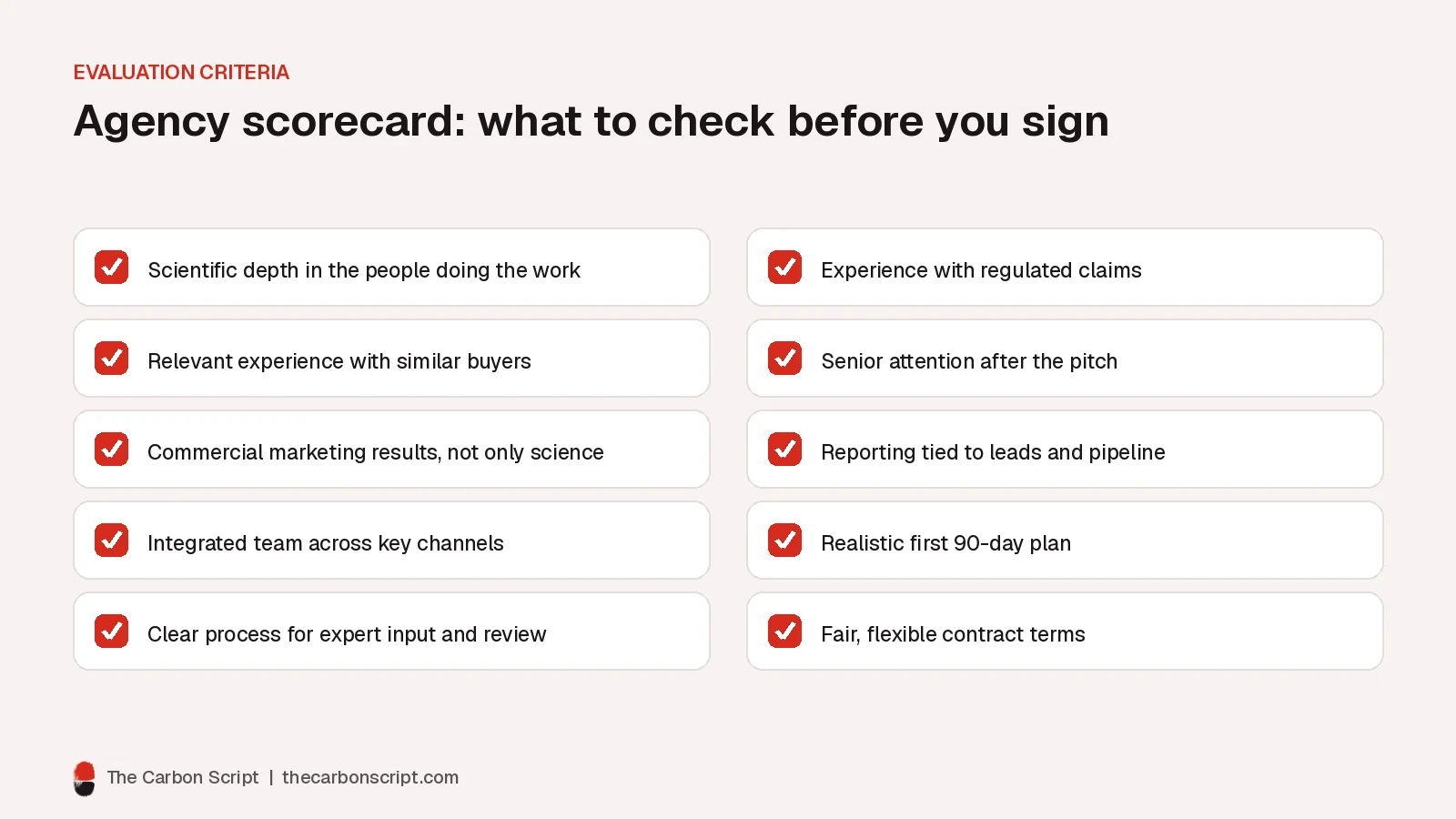
Scientific depth in the people doing the work
Ask who will plan and write your marketing, not just who will pitch it. Look for real research or technical backgrounds in the team you will work with day to day.
Experience with companies like yours
Selling a reagent to a lab, a device to a hospital and a biostimulant to a grower are very different. Ask for examples of work for companies with similar buyers, sales cycles and regulatory considerations.
Commercial results
Ask what changed for previous clients: qualified leads, pipeline, conversion rates, rankings or sales conversations. Good agencies can describe outcomes specifically, even when clients prefer not to be named.
An integrated approach
Your website, content, SEO, LinkedIn and paid campaigns should work from the same positioning. Agencies that handle several of these together usually produce more consistent results than a collection of separate suppliers.
A clear process for scientific input
Ask how they gather information from your experts and how review works. A good answer involves short interviews, accurate first drafts and one focused review round, rather than asking your scientists to write.
Regulatory awareness
Ask how they handle claims in your category and markets. For a device company, for example, they should know the difference between cleared and approved without being told.
Transparent measurement
Look for reporting tied to qualified leads, pipeline and revenue, not only traffic and impressions.
Questions to ask before you sign
- Who exactly will work on our account, and what are their backgrounds?
- Can you show work for companies with similar products and buyers?
- How do you gather information from our scientists, and how many review rounds should we expect?
- How do you handle regulated claims in our markets?
- What will you deliver in the first 90 days?
- How will you measure success, and how often will we see reports?
- What do you need from us to do your best work?
- What happens if we want to change scope or end the contract?
Green flags and red flags
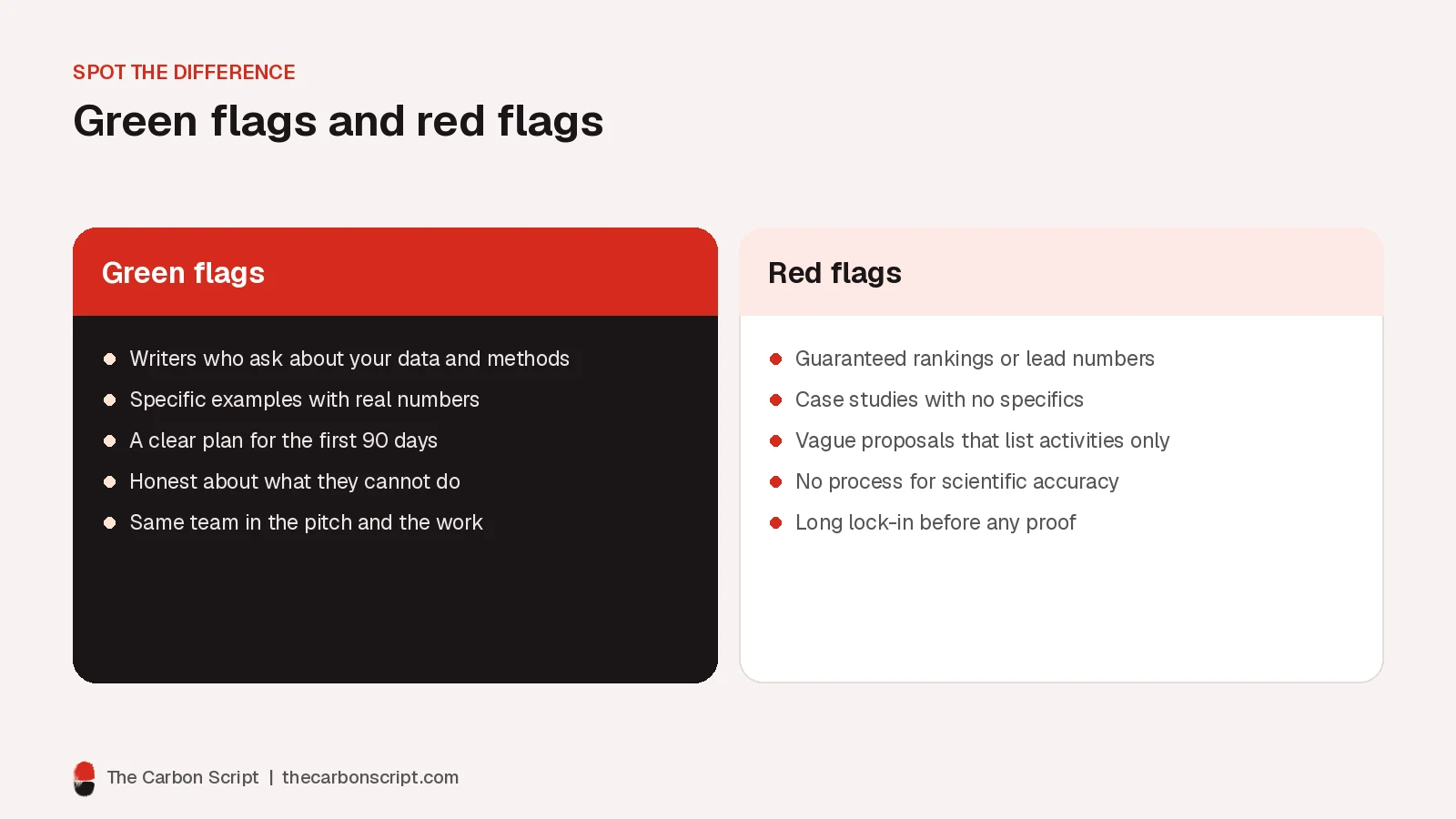
The most telling moment is often the first call. Agencies that understand life sciences ask about your data, methods, buyers and regulatory status before they talk about tactics. Agencies that do not tend to jump straight to deliverables.
A simple selection process
- Define the goal: a launch, a website, steady pipeline or a full marketing function.
- Set a budget range so proposals are comparable. Our guide to life science marketing costs can help.
- Shortlist three agencies with relevant experience.
- Brief them identically and ask the same questions.
- Score them against the same criteria, ideally with two or three colleagues.
- Check references with clients in similar sectors.
- Start with a defined project before committing to a long retainer.
Agency size and fit
Large agencies offer breadth and resources. Smaller specialist agencies often offer more senior attention and faster turnaround. Neither is better in general. The right choice depends on your budget, how much direction you need and whether your account will matter to the agency you choose.
Start small
If you are unsure, start with a defined project such as a positioning sprint, an SEO and AI search audit or a set of cornerstone articles. You will learn quickly how the agency works, how accurate it is and whether your team enjoys working with it. If you would like to see how we work, book a call and we will tell you honestly whether we are the right fit.
How to brief an agency
A good brief makes proposals better and easier to compare. Include:
- Who you are: what you do, your stage and your main products or services.
- Who you sell to: your buyers, their roles and how they decide.
- The goal: what success looks like in six to twelve months.
- What exists: website, content, data, brand assets and current results.
- Constraints: budget range, deadlines, regulatory considerations and review process.
- Decision process: who will choose and by when.
Questions a good agency will ask you
Pay attention to what agencies ask, not just what they answer. Strong life science agencies tend to ask who signs off on purchases, what evidence you have and how it is published, what regulatory status applies in each market, what your sales team hears most often, and how your scientists prefer to be involved. If an agency asks none of these, it is unlikely to understand your buyers.
What the first month should look like
Expect discovery interviews with your team and ideally a few customers, a review of your website, content and evidence, agreed goals and measures, and a clear plan for the first quarter. If the first deliverable arrives without that groundwork, the work is likely to be generic.
Frequently asked questions
What is the best life science marketing agency?
The best agency is the one with scientific depth in your area, strong commercial marketing skills, relevant experience and a process that fits your team. That differs from company to company.
Should a biotech marketing agency have scientists on staff?
Scientific training helps most when it sits with the people doing your work. Combine it with proven marketing results before deciding.
How long should an agency contract be?
Start with a project or a short initial term. A good agency should be confident enough to earn a longer engagement.
How many agencies should we talk to?
Three is usually enough to compare approaches and pricing without the process dragging on.
Should we choose an agency in our own country?
Not necessarily. Many life science agencies work remotely across time zones. Market knowledge and scientific depth matter more than location.
Want help putting this into practice?
We're a scientist-led marketing team for life science and technical companies. Tell us what you're working on and we'll show you where to start.
Book a call

