Key takeaways
- Scientific keywords often have low search volume but very high value. One qualified visitor can be worth a whole quarter of pipeline.
- Buyers search in a mix of technical and plain language, so your pages need both.
- The biggest technical problems on science websites are content locked in PDFs, thin product pages and slow, script-heavy pages.
- Authority comes from real expertise: named authors, citations and links from publications, associations and partners.
SEO for biotech and life science companies means helping your website rank for the searches scientific buyers actually make, from technical product terms and methods to the problems they are trying to solve. It works when you combine accurate, in-depth pages with sound technical foundations and authority earned from trusted sources in your field.
Life science buyers do a lot of research before they speak to sales. They search for methods, compare suppliers, look up specifications and read application notes. If your company does not appear for those searches, you are invisible during the most important part of the buying process. This guide covers what matters most.
Why SEO matters for biotech companies
Search captures demand that already exists. Someone typing "CRISPR screening services for primary cells" or "GMP plasmid manufacturing timeline" is not browsing. They have a problem and are actively looking for a supplier. Being visible at that moment is one of the most cost-effective forms of marketing a science company can do, and the visibility compounds over time in a way paid campaigns do not.
SEO now also feeds AI search. Google says its AI Overviews rely on the same ranking systems as regular search, so the work you do here also improves your chances of being cited in AI answers. Our guide to AI search for life science companies covers the extra steps.
Keyword research for scientific terms
Standard keyword tools often show zero or very low volume for technical terms. Do not let that put you off. A search like "single-cell ATAC-seq kit" may only be typed a few dozen times a month, but almost everyone typing it is a potential buyer.
Where to find the right keywords
- Sales and support: the exact language prospects use in calls, emails and tickets.
- Google Search Console: the queries already bringing people to your site.
- Competitor pages: the terms used on pages that rank for your topics.
- Scientific literature: the terms researchers use in papers in your area.
- Keyword tools: Google Keyword Planner and paid tools for volume and difficulty, treated as a guide rather than the truth.
Cover technical and plain-language variants
Include acronyms and spelled-out versions, technical names and plain-language problems, and regional differences, since US and UK buyers sometimes search differently. A page about "NGS library prep" should also make sense to someone searching "next-generation sequencing library preparation".
Match each search to the right page
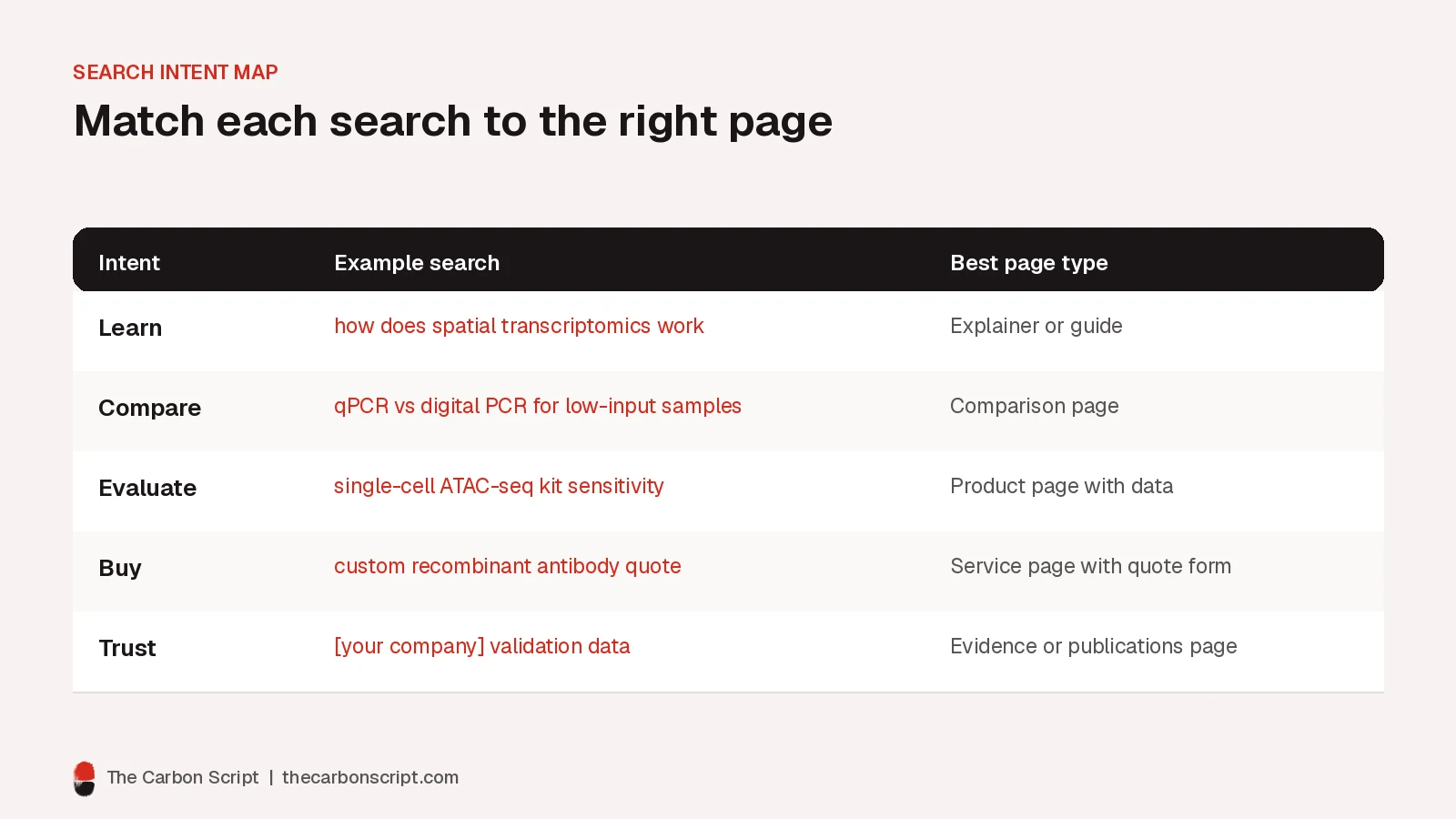
Group keywords by intent. Some people are learning, some are comparing, some are evaluating a product and some are ready to buy. Each needs a different kind of page, and trying to force every intent onto one product page usually means ranking for none of them.
The pages that rank in life sciences
- Application and use-case pages that explain how your product solves a specific problem, with methods and data.
- Product pages with full specifications, performance data and documentation, not a paragraph and a contact form.
- Comparison pages that honestly explain how your approach differs from alternatives.
- Explainers and guides for the concepts and techniques your buyers research.
- Glossaries for terminology in your field, linked to deeper pages.
- Case studies showing real customers and measured results.
- Service pages for CROs and CDMOs, one per capability, with clear scope, quality information and a quote request.
The common thread is depth. Thin pages rarely rank for competitive scientific terms, and they do not convince expert readers either.
Technical SEO issues on science websites
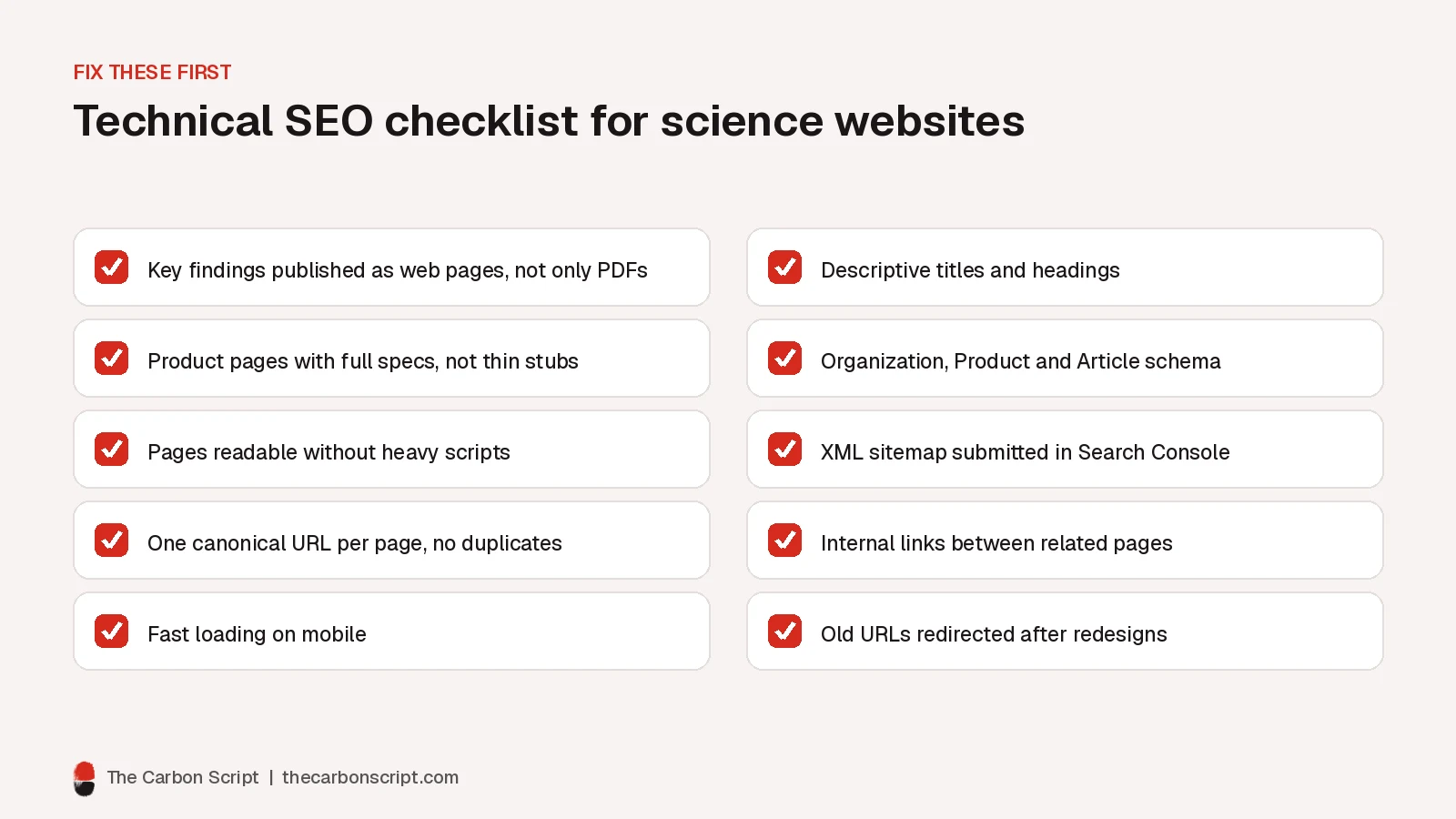
The single most common problem is that the best content lives in PDFs. Application notes, white papers and datasheets often exist only as downloads. Publish the key content as a web page and offer the PDF alongside it.
Other frequent issues include product catalogs with duplicate or near-empty pages, sites built so heavily on scripts that search engines struggle to render them, slow pages weighed down by large images, missing redirects after a redesign and missing structured data. Organization, Product, Article and FAQ markup help search engines understand your content, as long as the markup matches what is visible on the page.
On-page SEO for scientific content
- Titles: lead with the main term in natural language, under about 60 characters.
- Headings: one clear H1, then descriptive H2s that mirror the questions people ask.
- First paragraph: answer the main question directly in the first two sentences.
- Depth: cover the related subtopics a buyer would expect, not just the keyword.
- Internal links: connect explainers to product pages and product pages to case studies.
- Images: compress them and write descriptive alt text.
Expertise and trust
Google's guidance on creating helpful, reliable, people-first content puts strong emphasis on experience, expertise, authoritativeness and trust, often shortened to E-E-A-T. Life science companies have a natural advantage here if they show it:
- Put author names and credentials on articles.
- Add "reviewed by" lines for technical content.
- Cite sources and link to your own publications.
- Explain your team's scientific background specifically on your About page.
- Show certifications, partners and real customers.
Earning links and mentions
The best links in life sciences come from places your buyers already trust: scientific societies, universities and research institutes you work with, trade publications, conference organizers, distributors and partners. Contribute expert articles, share data, speak at events and make sure every partner page that mentions you links to you. A handful of relevant, authoritative links is worth far more than many unrelated ones.
Do biotech companies need local SEO?
Usually only if buyers search by location, for example "CRO in Boston" or "analytical testing lab near Cambridge". In that case, a location page with genuine local information helps. Most B2B life science companies selling nationally or internationally should focus on topic authority rather than local rankings.
How to measure SEO success
- Rankings for priority terms, tracked monthly.
- Organic visits to product, application and service pages, not just the blog.
- Conversions from organic search: demo, quote and sample requests.
- Pipeline influenced, connecting Search Console and analytics to your CRM.
Expect movement in three to six months for specific technical terms, and longer for broad, competitive ones. If you want help building or fixing this, our SEO and AI search service starts with a full audit.
Common biotech SEO mistakes
- Targeting only broad terms such as "biotech" or "cell culture" that are too competitive and too vague to convert.
- Hiding expertise in PDFs, so the content that would rank is invisible to search engines.
- Launching a new website without redirects, losing rankings that took years to build.
- Publishing thin blog posts that summarize other people's work without adding expertise.
- Ignoring product and service pages, which are usually the pages that convert.
- Measuring traffic instead of leads, which rewards the wrong content.
A 90-day biotech SEO plan
- Weeks 1 to 4: technical audit, Search Console and Bing Webmaster Tools setup, keyword research and a map of priority pages.
- Weeks 5 to 8: fix technical issues, improve titles and headings on product and service pages, and publish key PDF content as web pages.
- Weeks 9 to 12: publish two or three in-depth pages for high-value topics, add internal links and start earning links from partners and publications.
After the first quarter, review which queries are gaining impressions in Search Console and build more depth around the topics that are starting to move.
Frequently asked questions
How long does SEO take for a biotech company?
Most see movement within three to six months, with stronger results after six to twelve months of consistent work. Niche technical terms often move faster than broad competitive ones.
Is SEO worth it if our keywords have low search volume?
Usually, yes. In life sciences, low-volume keywords tend to be specific and commercially valuable. A handful of the right visitors can matter more than thousands of the wrong ones.
Should we publish our application notes as web pages?
Yes. Publish the key content as a page with headings and figures, and keep the PDF as a download. Pages are much easier for search engines and AI tools to read and cite.
What is the difference between SEO and AI search optimization?
SEO focuses on ranking in search results. AI search optimization focuses on being cited in AI-generated answers. They share the same foundations, and AI search adds extra emphasis on specific, evidence-backed claims.
Do we need a separate SEO strategy for the US and UK?
Not usually a separate strategy, but your keyword research should include regional terms and spellings, and your content should reflect the regulatory language that applies in each market.
Sources
Want help putting this into practice?
We're a scientist-led marketing team for life science and technical companies. Tell us what you're working on and we'll show you where to start.
Book a call

