
Key takeaways
- Scientific buyers value content that helps them do their work: application notes, protocols, comparisons and data.
- Your own research is your best content source. One paper can become many useful assets.
- Slow scientific review kills most content programs. Interviews and one focused review round fix it.
- Measure content by the conversations and pipeline it creates, not the views it gets.
Life science content marketing is the practice of creating accurate, useful content, such as explainers, application notes, white papers, case studies and articles, that helps scientific buyers understand a problem and trust your solution. Done well, it ranks on Google, gets cited by AI tools, gives your sales team something credible to send and builds your reputation as the expert in your niche.
Most life science companies know they should be producing content. Many have tried and ended up with a blog nobody reads and a backlog of drafts stuck in review. The problem is rarely effort. It is usually that the content is not useful enough to an expert reader, or that the process for getting it published does not work. This guide covers both.
Why content matters more in life sciences
Life science buyers research thoroughly before they talk to a supplier. They read methods, compare approaches and look for evidence. Content is how you show up during that research with something genuinely helpful, and how you prove you understand their science before a single sales call. It also compounds: a strong application page or guide can bring in qualified visitors for years.
The content types that work
- Application notes and use cases show your product performing on a real problem, with methods and data.
- Explainers and guides cover the concepts and techniques your buyers are researching.
- Comparison guides help buyers choose between methods or approaches, honestly.
- Case studies show results in a customer's own words, with numbers.
- White papers go deep on a single important question. Our guide to writing a scientific white paper explains how to make one people finish.
- Webinars and expert interviews put your scientists in front of buyers.
- Data stories turn results into short, visual pieces for LinkedIn and email.
- Protocols and technical resources that customers bookmark and return to.
Content for each stage of the buying journey
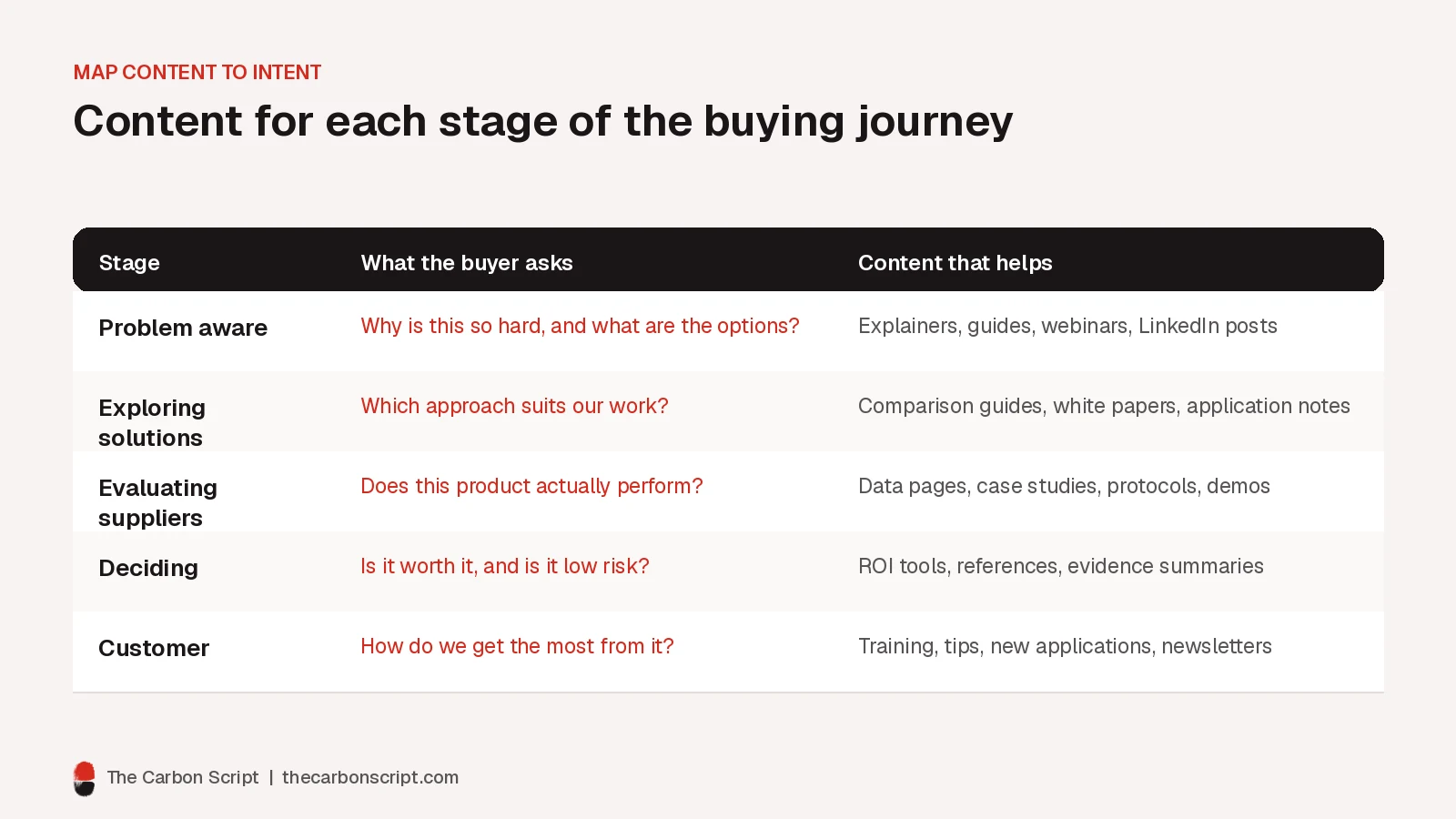
A common pattern is a blog full of broad awareness articles and almost nothing for buyers who are actively evaluating suppliers. Those evaluation-stage pieces, such as data pages, comparisons and case studies, are usually what moves a deal forward, so make sure your plan includes them.
Turn one paper into a month of content
Every publication, poster or dataset your team produces can feed your content program for weeks. From a single paper you might create a plain-language summary page, a short video with the lead author, a LinkedIn carousel of the key figures, an email to customers, a sales one-pager, a webinar, a blog post on the wider implications and an FAQ for your support team.
This keeps content grounded in real evidence, which builds trust with expert readers and gives AI tools something concrete to cite. Our guide to AI search for life science companies explains why that matters.
Building a content strategy
- Start from buyer questions. Collect them from sales calls, support tickets, conference conversations and search data.
- Map them to stages and audiences. A lab manager and a procurement lead need different answers.
- Inventory your evidence. Papers, datasets, customer results and expert knowledge you can draw on.
- Choose cornerstone pieces that answer the most important questions in depth.
- Plan distribution before writing: search, LinkedIn, email, sales and events.
How much to publish
Consistency beats volume. Two genuinely useful pieces a month, promoted properly, usually outperform ten thin ones. Build a simple editorial calendar tied to product launches, conferences, publications and the questions your sales team hears most.
Fix the scientific review bottleneck
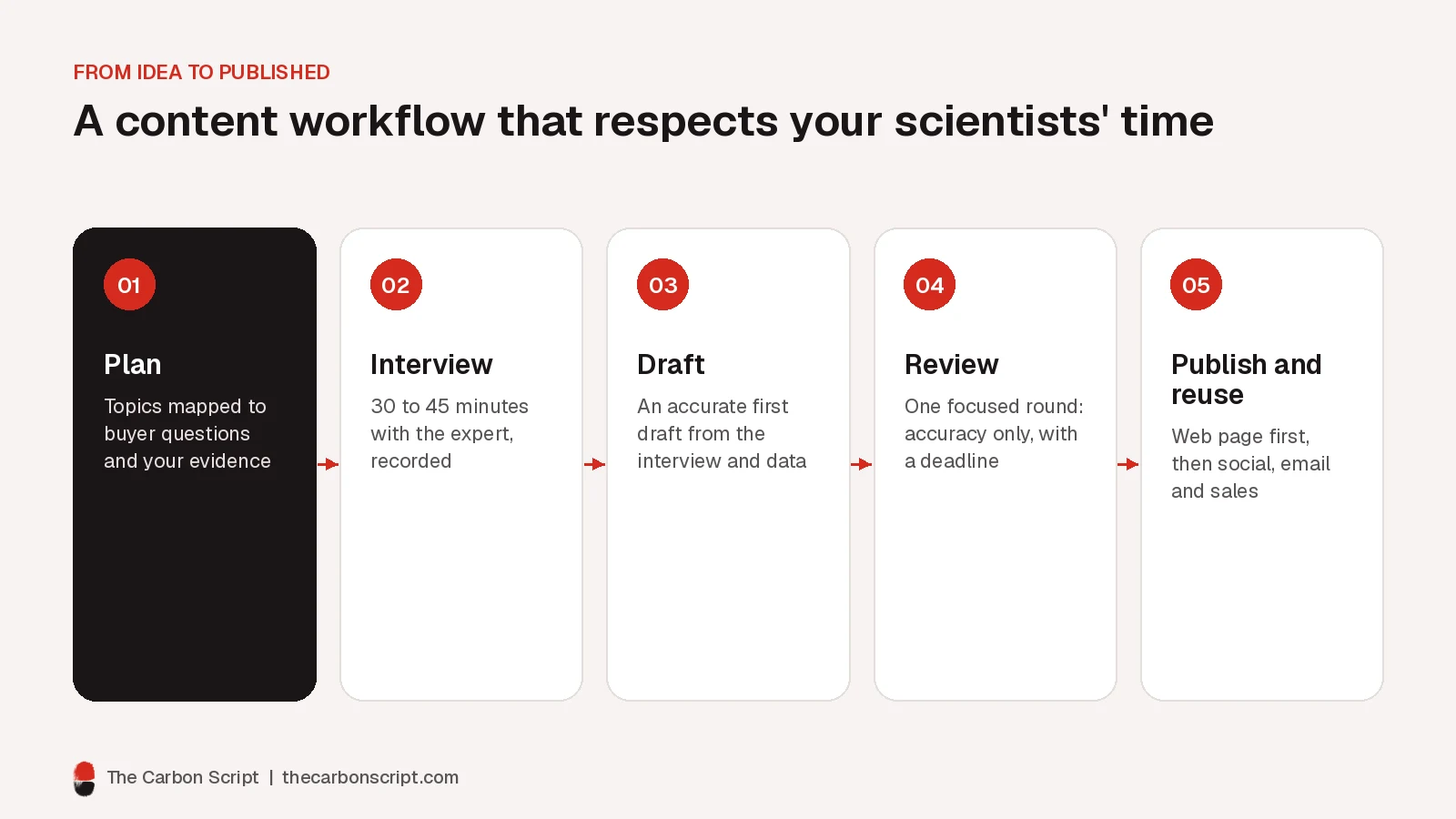
Scientific review is where content programs stall. Writers send a draft, scientists rewrite it, marketing softens it, and three rounds later everyone is frustrated. A few changes make a big difference:
- Interview subject matter experts for 30 to 45 minutes instead of asking them to write.
- Agree up front what reviewers check: accuracy, not style.
- Name one reviewer per piece and set a clear deadline.
- Keep a shared claims library so approved language can be reused.
The biggest fix is having writers who understand the science in the first place. When the first draft is accurate, review takes one round instead of four. That is the core of how we approach scientific content marketing.
Writing for expert and commercial readers
Most life science content has two readers: the expert who checks the science and the buyer who needs the implication. Serve both by stating each section's main point in plain language first, then providing the detail. Use descriptive headings, put numbers next to claims, cite sources and avoid buzzwords such as "revolutionary" or "cutting-edge", which experts tend to distrust.
Distribution matters as much as writing
Publish on your website first, so search engines and AI tools can find it. Then share it through LinkedIn, from both your company page and your scientists' own profiles, through email, through sales teams and at events. Repurpose the strongest pieces into multiple formats over time.
How to measure content marketing
- Organic traffic to key pages and the queries driving it.
- Engagement such as time on page and newsletter signups.
- Conversions: demo, quote or sample requests that started on a content page.
- Sales usage: how often reps send a piece to prospects.
- Pipeline influenced, connected through your CRM.
Content ideas by sector
- Biotech: plain-language explainers of your science, pipeline updates, publication summaries and founder perspectives.
- MedTech: technique guides, evidence summaries, economic models and clinician interviews.
- CROs and CDMOs: capability deep dives, process explainers, quality and compliance content, and sponsor case studies.
- Life science tools: application notes, protocols, comparison guides and troubleshooting resources.
- Agtech: field trial summaries, agronomy guides, return-on-investment tools and grower stories.
One cornerstone piece, many formats
Treat your best pieces as cornerstones and plan how each one will be reused:
- A long guide becomes a series of LinkedIn posts and a newsletter feature.
- A webinar becomes a recording page, short video clips and a written summary.
- A case study becomes a sales one-pager, a conference slide and a social post.
- An application note becomes a product page section and an email to relevant customers.
This approach means fewer new pieces, more reach for each one and a far lighter load on your scientists.
Using AI tools responsibly
AI tools can speed up research, outlines and first drafts, but they also make confident mistakes with scientific detail. Keep a human expert responsible for every claim, check numbers against the original source and add the first-hand experience only your team has. That experience is exactly what makes content worth reading and citing.
Frequently asked questions
Who should write life science content?
Ideally, writers with scientific backgrounds who can interview your experts, understand the data and write for both technical and commercial readers. That keeps accuracy high and review cycles short.
Should life science content be gated?
Gate sparingly. Keep most content open so buyers and search engines can find it, and reserve gating for high-value assets such as in-depth reports or tools.
How technical should life science content be?
As technical as your audience needs, and no more. Lead with the main point in plain language, then provide depth for readers who want it.
How often should a biotech company publish?
Two useful, well-promoted pieces a month is a realistic and effective rhythm for most teams.
Can AI tools write life science content?
They can help with research and drafting, but expert review and first-hand experience remain essential. Google's guidance focuses on whether content is helpful and reliable, however it is produced.
Want help putting this into practice?
We're a scientist-led marketing team for life science and technical companies. Tell us what you're working on and we'll show you where to start.
Book a call

