
Key takeaways
- Life science marketing helps companies built on biology, chemistry and engineering reach and persuade expert buyers, partners and investors.
- It differs from general B2B marketing in five ways: expert audiences, committee buying, regulation, the weight placed on evidence and long sales cycles.
- Positioning comes first. Websites, content, SEO, paid media and social all perform better once the core message is clear.
- Many companies use outside help. In SCORR Marketing's 2024 industry survey, 61% of respondents said their company contracted work through an external marketing agency that year.
Life science marketing is the work of helping companies whose products come out of the lab, the clinic or the field reach and persuade the people who buy, approve and fund them. It covers biotech and biopharma, medical devices and diagnostics, contract research and manufacturing organizations, life science tools and reagents, agtech and the scientific service providers that support all of them.
The toolkit looks familiar: positioning, a website, content, search, paid media, social and email. What makes it a discipline of its own is the audience. Buyers are often scientists or clinicians, decisions involve committees, claims are regulated, and evidence matters more than slogans. This guide explains how it works, who you are really marketing to, and how to build a plan that holds up with expert readers.
Life science marketing, defined
At its simplest, life science marketing turns scientific capability into commercial demand. That means explaining what a product or service does, proving that it works, and making it easy for the right people to take the next step, whether that is requesting a demo, a quote, a sample or a partnership conversation.
The term is used broadly. Some people use "life sciences marketing" to include pharmaceutical brand marketing aimed at patients and prescribers. In practice, most life science marketing is business to business: a company selling to labs, hospitals, sponsors, growers, distributors or other companies. That is the focus of this guide.
Which companies does it cover?
The common thread is a product or service built on science and sold to people who understand science. Typical examples include:
- Biotech and biopharma: therapeutics developers, platform companies, synthetic biology and cell and gene therapy.
- MedTech and medical devices: surgical and diagnostic equipment, digital health and software as a medical device.
- CROs and CDMOs: contract research and contract development and manufacturing organizations.
- Life science tools and diagnostics: instruments, reagents, assays, lab automation and scientific software.
- Agtech and plant science: biologicals, biostimulants, crop protection and precision agriculture.
How life science marketing differs from general B2B marketing
1. Your buyers are experts
A principal investigator, lab director or interventional cardiologist will spot a vague or inflated claim in seconds. Language that works on a general business audience can actively damage credibility here. The bar for accuracy is higher, and so is the bar for usefulness: expert buyers want specifications, methods and data, not adjectives.
2. Buying is a group decision
The scientist who wants your product is rarely the person who signs the purchase order. Procurement, finance, quality, IT and leadership often have a say, and each cares about something different. In US hospitals, for example, value analysis committees review new products against clinical evidence, cost and alternatives before they are approved.
3. Regulation shapes what you can say
Depending on the product and the market, rules from bodies such as the FDA in the US and the MHRA in the UK govern how you describe safety, performance and intended use. The wording matters: a medical device that reaches the US market through the 510(k) pathway is "FDA cleared", not "FDA approved". Good marketing works inside those limits without becoming lifeless.
4. Evidence does the persuading
Validation data, peer-reviewed papers, trial results and case studies carry far more weight than brand claims. The companies that win are usually the ones that make their evidence easiest to find, understand and share.
5. Sales cycles are long
A reagent might be bought in weeks, but capital equipment, CRO contracts and clinical tools can take many months to close. Marketing has to keep you visible and credible across the whole cycle, not just at launch.
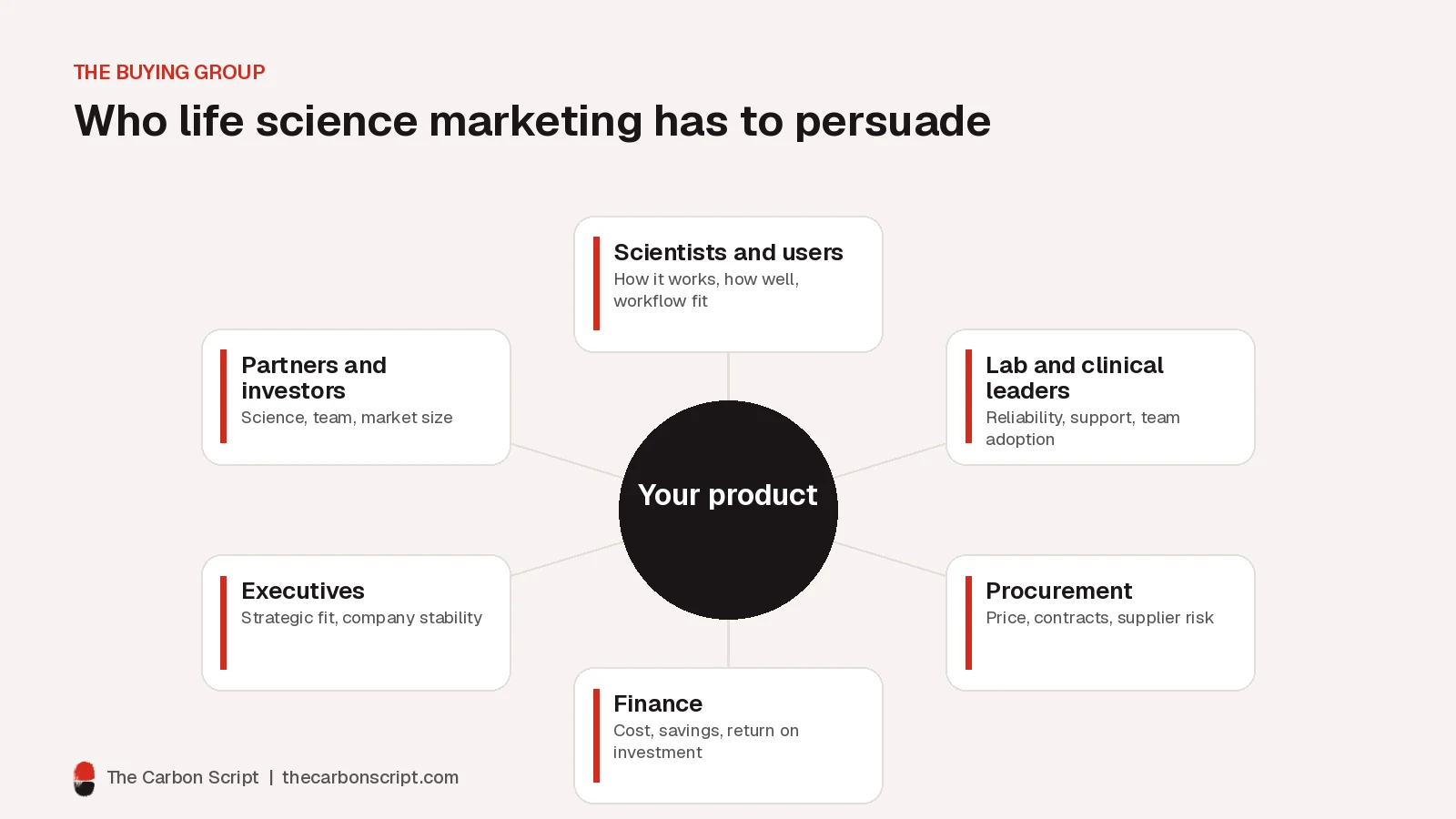
Who you are actually marketing to
Most life science companies sell to several groups at once, and the same message rarely works for all of them. Mapping them is the single most useful planning exercise you can do.
- Technical users such as scientists, clinicians, engineers and agronomists want to know how it works, how well it works and whether it fits their workflow.
- Technical leaders such as lab managers and department heads care about reliability, support, training and how their team will adopt it.
- Economic buyers in procurement and finance want price, contract terms, total cost and supplier risk.
- Executives want strategic fit and confidence that your company will be around to support the product.
- Partners and investors want the science, the team and the size of the opportunity.
For each group, write down what they need to believe before they say yes, and what evidence would convince them. That list becomes the backbone of your messaging, your website structure and your content plan.
The six building blocks of a life science marketing plan
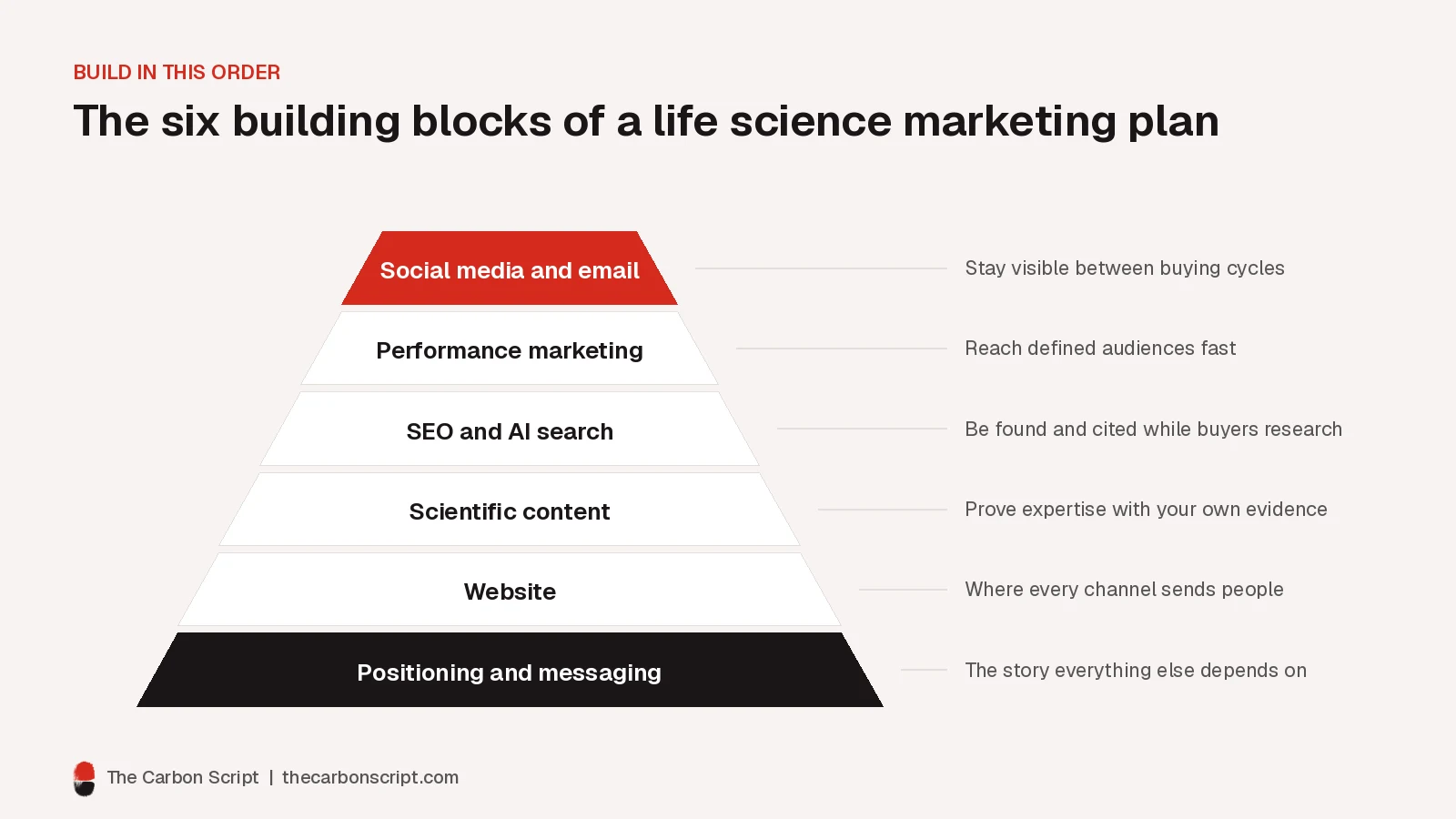
Positioning and messaging
Before anything else, you need one clear way to describe what you do, who it is for and why it is better. Positioning is the part most teams skip, and the main reason so many science websites sound the same. Our guide to positioning a biotech company walks through a practical framework.
A website that converts experts
Your website is where every other channel sends people. It needs clear paths for each audience, detailed product and application pages, visible evidence and an obvious next step, whether that is a demo, a quote or a sample request.
Scientific content
Application notes, explainers, white papers, case studies and articles are how you show expertise at scale. The best content starts from your own data and answers the questions buyers actually ask.
SEO and AI search
Technical buyers research long before they speak to sales, on Google and increasingly in AI tools such as ChatGPT and Perplexity. SEO and AI search optimization make sure you are found, and described accurately, when they do.
Performance marketing
Google Ads and LinkedIn Ads let you reach precise audiences quickly, test messages and support launches. Paid media works best once positioning and landing pages are solid, because it amplifies whatever message you give it.
Social media and email
LinkedIn and email keep you visible between buying cycles and give your scientists a voice. Consistent programs turn one-off visitors into an audience that remembers you when they are ready to buy.
Channels that matter most in life sciences
Channel mix depends on your sector, but a few patterns hold across most life science companies.
- Conferences and trade shows remain central for relationship building and partnering. In SCORR Marketing's 2024 survey, half of respondents said their companies increased trade show investment that year.
- Search captures people actively researching a method, product or supplier, often with highly specific, low-volume queries that are worth a lot.
- LinkedIn reaches scientists, procurement leaders and executives in a professional setting, both organically and through targeted ads.
- Email nurtures long sales cycles and keeps existing customers informed about new applications and products.
- Trade publications and podcasts build credibility through third-party coverage and expert contributions.
Compliance without lifeless copy
Regulated claims are a fact of life in many life science categories, but they should not make your marketing vague. The practical approach is to agree a claims framework with your regulatory and legal colleagues early, then write clearly and specifically inside it. A few habits help:
- Use the exact regulatory status for each market, such as cleared, approved, CE marked or research use only.
- Only promote indications and uses you are authorized to promote.
- Put numbers, sample sizes and conditions next to performance claims, and link to the source.
- Keep one shared claims library so the website, sales deck and campaigns say the same thing.
How much should you spend?
There is no universal figure. Spend depends on your stage, your sales model and how much of the work you do in-house. Early-stage companies often invest first in positioning and a credible website, then add content and search. Commercial-stage companies typically run ongoing programs across content, SEO, paid media and events. Our guide to life science marketing costs explains the pricing models agencies use and what drives the numbers.
Common life science marketing mistakes
- Leading with the technology instead of the outcome. Buyers care what your platform lets them do, not how elegant the method is.
- Drowning everything in jargon, or swinging the other way and simplifying until the science stops being true.
- Hiding the best evidence in gated PDFs that neither buyers nor search engines can easily find.
- Running disconnected campaigns with no shared positioning, so every channel tells a slightly different story.
- Measuring the wrong things, such as impressions and followers, instead of qualified conversations and pipeline.
How to build your plan, step by step
- Agree your positioning and the core message for each audience.
- Audit what you have: website, content, evidence, search visibility and what AI tools say about you.
- Fix the website first, because every other channel depends on it.
- Build a content engine from your own research, data and customer questions.
- Add distribution through SEO, LinkedIn, email, events and paid media.
- Measure what matters: qualified leads, pipeline influenced and sales conversations.
In-house team, agency or both?
Many life science companies use a mix. A specialist agency makes sense when your scientists keep rewriting what marketing produces, when a launch is coming and there is no time to build a team, or when one marketer is covering everything. An in-house lead becomes valuable once there is a steady commercial workload and someone needs to own priorities day to day. If you are weighing the options, our guide to choosing a life science marketing agency covers what to look for and what to ask.
Frequently asked questions
What does a life science marketing agency do?
It plans and runs marketing for companies in biotech, MedTech, diagnostics, CROs, life science tools and agtech. That usually includes positioning, websites, content, SEO, paid media, social and email, delivered by people who understand the science well enough to explain it accurately.
How is life science marketing different from healthcare marketing?
Healthcare marketing often targets patients and consumers. Life science marketing is mostly business to business, aimed at scientists, clinicians, procurement teams and partners, and it relies far more on technical evidence.
What is the most important part of a life science marketing strategy?
Clear positioning. When you can explain who you serve, what problem you solve and why your approach is better in plain language, every other channel becomes more effective.
How long does life science marketing take to show results?
Paid campaigns can generate leads within weeks. Positioning, content and SEO build over months. Most companies see meaningful pipeline impact within two to three quarters of consistent work.
Do life science companies need to worry about AI search?
Increasingly, yes. Buyers use tools like ChatGPT and Perplexity to build shortlists, so it matters whether those tools can find and accurately describe your company and its evidence.
Sources
Want help putting this into practice?
We're a scientist-led marketing team for life science and technical companies. Tell us what you're working on and we'll show you where to start.
Book a call

