
Key takeaways
- Most science companies describe what their technology is. Buyers want to know what it lets them do.
- A strong position covers six things: category, audience, problem, mechanism, proof and outcome.
- The mechanism sentence, how it works in plain words, is the most powerful line you will write.
- Branding is more than a logo. The verbal identity, meaning what you say and how you say it, matters most.
To position a biotech company, decide exactly who you serve, what problem you solve, how your approach works and why it is better, then express that in one clear statement backed by evidence. Branding turns that position into a consistent verbal and visual identity across your website, deck, LinkedIn and campaigns, so every team tells the same story.
Ask five people at a science company what the company does and you will often hear five different answers. The CEO describes the vision, the CSO describes the platform, sales describes the product and the website describes something else. That is a positioning problem, and it costs more than most companies realize: longer sales cycles, confused investors and marketing that never quite lands.
Positioning, messaging and branding: what is the difference?
- Positioning is the strategic choice of who you serve, what problem you solve and why your approach is better than the alternatives.
- Messaging is the language you use to communicate that position to each audience.
- Branding is the whole identity people experience: the name, voice, visual design and reputation built on that position.
They work in that order. A beautiful brand built on a vague position still leaves people unsure what you do.
Why science companies struggle with positioning
Deep expertise makes it hard to see your work from the outside. The details that matter most to your team, such as the method, the novelty and the elegance, are rarely what matters most to a buyer. Add a technology that can be used in many ways, and the temptation is to describe everything. The result sounds impressive and says very little.
A six-part positioning framework
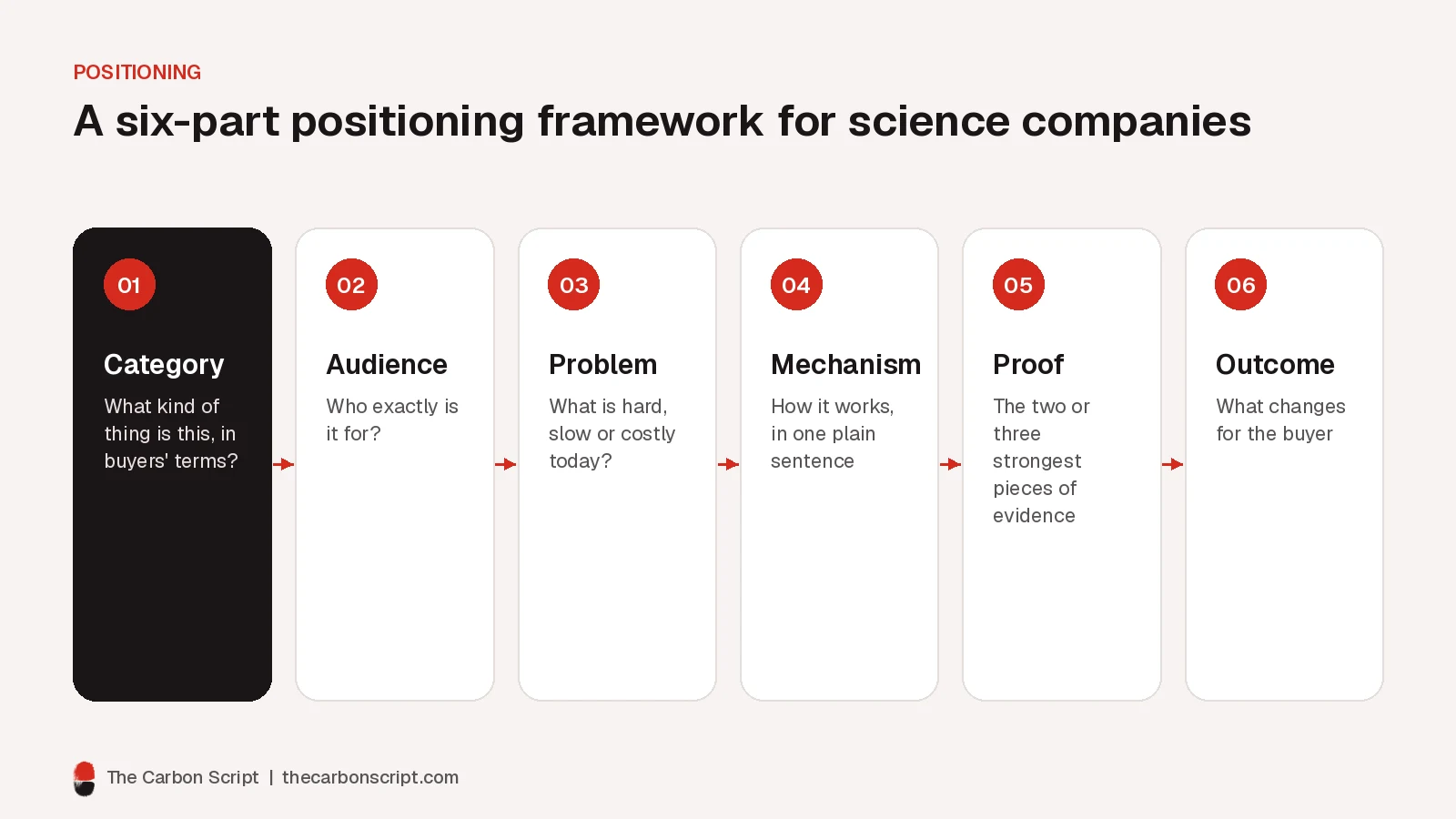
1. Category
What kind of thing is this, in terms a buyer already understands? A spatial biology platform, a rapid diagnostic, a biostimulant or a contract research service. If you are creating a new category, anchor it to one people already know.
2. Audience
Who is it for, specifically? "Researchers" is too broad. "Translational oncology labs running high-plex tissue studies" gives you something to build on.
3. Problem
What is hard, slow, expensive or impossible for them today? Describe it in their words, ideally the words you hear on sales calls.
4. Mechanism
How does your approach solve it, in one plain sentence? This is the line that earns trust from experts and clarity for everyone else.
5. Proof
What evidence shows it works? Data, publications, customer results or regulatory status. Choose the two or three strongest points.
6. Outcome
What changes for the buyer? Time saved, accuracy gained, costs reduced or new questions answered. This is what they are actually buying.
Write your mechanism sentence
The mechanism sentence explains how it works without jargon and without oversimplifying. For example: "Our sensor uses radar to measure water levels from above the river, so it keeps working through floods that destroy in-water equipment." A good mechanism sentence makes an expert nod and a non-expert understand.
Draft ten versions. Test them on people outside your field and on a few customers. Keep the one that people can repeat back accurately.
Positioning a platform company
Platform companies face a specific trap: because the technology can do many things, the messaging tries to cover all of them. Lead instead with one or two applications where you have the strongest proof and the clearest buyer, and describe the platform as the reason you can do them better. Expand the story as each foothold is established. Our guide to marketing a biotech company covers how this changes by stage.
Build a message house
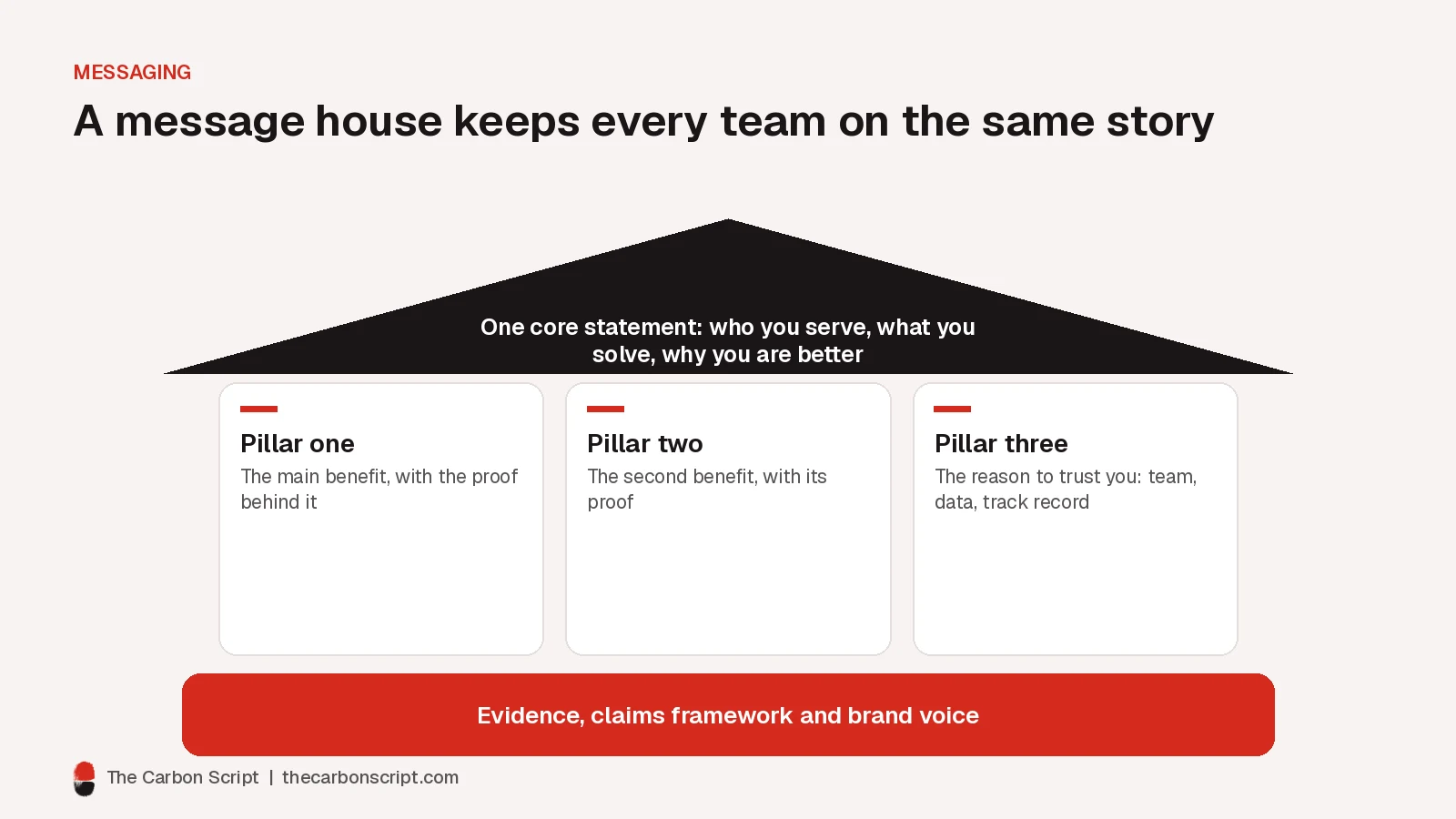
A message house is a one-page tool that turns your position into messaging every team can use. The roof is your core statement. The pillars are the two or three main benefits, each with its proof. The foundation is your evidence, claims framework and brand voice.
Keep the house the same for every audience, but change the emphasis. Scientists need more mechanism and proof. Procurement and finance need more outcome and cost. Investors need the size of the problem and why you will win.
From positioning to brand
Verbal identity
Your brand voice should sound like your best scientist explaining the work to a smart colleague from another field: confident, precise and clear. Write a short voice guide with examples of what you say and what you avoid.
Visual identity
Your logo, colors and typography should feel as credible as your science. Avoid the visual clichés of the category, such as generic DNA helices and stock lab photos, if you want to stand out. Consistency across every touchpoint matters more than any single design choice.
Naming
If you are naming a company, platform or product, check that the name works internationally, is easy to say and spell, and is available as a trademark and domain in your key markets.
Test before you commit
- Try messages in sales conversations and note what makes people lean in.
- Run small LinkedIn or search ad tests with different headlines and compare engagement and conversion.
- Ask a few friendly customers to explain your company back to you.
- Check whether a new visitor understands your homepage within five seconds.
Common positioning traps
- Leading with "AI-powered" or "next-generation" without saying what it does.
- Listing every possible application.
- Using internal names for products and methods that nobody outside the company knows.
- Promising outcomes the evidence does not yet support.
- Changing the message every quarter.
Rolling it out
Once the position is agreed, apply it to your website, sales deck, LinkedIn profiles, conference materials and content plan. Brief everyone who talks about the company. That consistency is what makes a young company feel established. If you would like help building it, our branding and positioning work starts here.
Positioning examples: before and after
The examples below are illustrative, but they show the shift from describing technology to describing value.
- Before: "A next-generation multi-omics platform powered by AI." After: "We help translational oncology teams find biomarkers in tissue samples they already have, in weeks instead of months."
- Before: "Innovative solutions for sustainable agriculture." After: "A microbial seed treatment that helps corn hold yield in dry seasons, proven in replicated trials across three states."
- Before: "A leading partner for drug development." After: "A preclinical CRO specializing in rare disease models, with study start in under four weeks."
A simple positioning workshop
- Before the workshop: interview five to ten customers, partners or lost prospects, and collect how competitors describe themselves.
- Session one: agree the category, audience and problem, using customer language.
- Session two: draft mechanism sentences and choose the strongest proof points.
- Session three: write the core statement and the message house, then plan how to test it.
Involve the CEO, scientific lead and whoever owns sales. Positioning that only marketing agrees with rarely survives first contact with the rest of the company.
Frequently asked questions
What is the difference between positioning and messaging?
Positioning is the strategic choice of who you serve, what problem you solve and why you are better. Messaging is the language you use to communicate that position to different audiences.
How long does a positioning project take?
A focused positioning and messaging project usually takes four to eight weeks, including interviews with your team and customers, drafting and testing.
How much does biotech branding cost?
It depends on scope. A positioning and messaging project costs far less than a full rebrand with naming and visual identity. Get a fixed quote based on what you actually need.
When should a science company revisit its positioning?
After a major product launch, a change in target market, a funding round that shifts strategy, or when sales consistently reports that buyers are confused.
Do we need a new logo to reposition?
Not necessarily. Many companies keep their visual identity and update only their positioning and messaging.
Want help putting this into practice?
We're a scientist-led marketing team for life science and technical companies. Tell us what you're working on and we'll show you where to start.
Book a call

