
Key takeaways
- Agencies usually charge in one of three ways: fixed-fee projects, monthly retainers or fractional marketing teams.
- Published figures vary widely. One US agency says its life sciences clients generally invest between $3,000 and $30,000 a month.
- Scope and the number of channels drive most of the cost. Paid media spend is almost always on top of agency fees.
- The cheapest option often costs more once you count the hours your scientists spend rewriting inaccurate work.
A life science marketing agency typically costs anywhere from a few thousand to tens of thousands of dollars a month for ongoing work, with one-off projects such as positioning or a new website priced as a fixed fee. The final number depends on scope, the number of channels, how much new content is needed and how scientifically complex the work is. Paid media spend is usually billed separately.
It is one of the first questions science companies ask, and one of the hardest to get a straight answer to. This guide explains how agencies price their work, what affects the number, how to compare proposals and how to set a realistic budget.
How life science marketing agencies charge
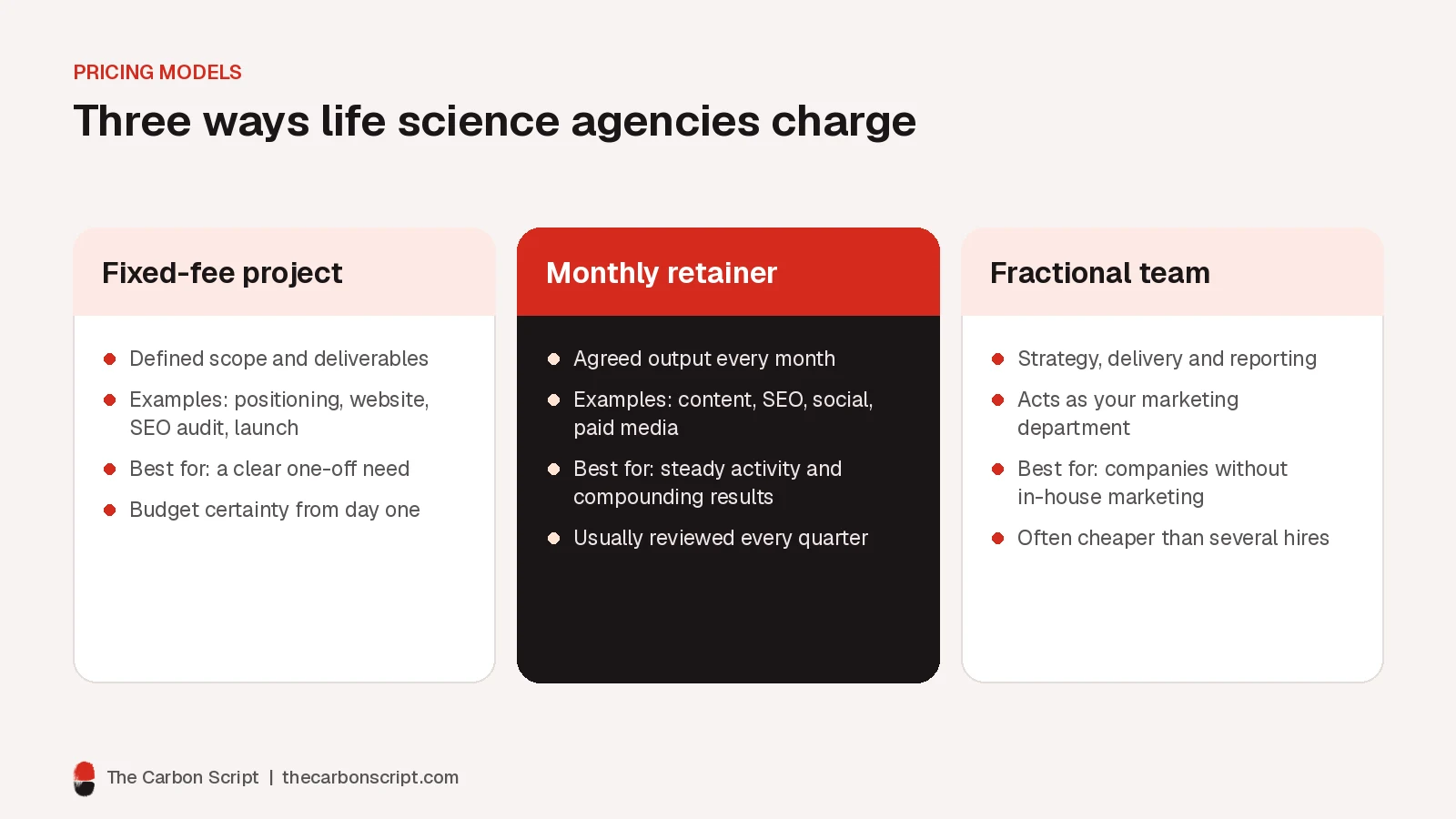
Fixed-fee projects
Work with a clear start and end, such as a positioning project, a new website, an SEO audit or a launch campaign, is usually priced as a fixed fee. You agree the scope and deliverables up front, which makes budgeting simple and limits risk.
Monthly retainers
Ongoing work such as content, SEO, social media and paid campaign management is usually a monthly retainer covering an agreed amount of output. Retainers suit companies that want steady activity and results that build over time.
Fractional marketing teams
For companies without in-house marketing, some agencies act as the whole team, providing strategy, delivery and reporting for a monthly fee. This is often more affordable than hiring several specialists and faster than building a team from scratch.
Hourly and performance-based pricing
Some agencies bill by the hour for advisory work, and a few offer performance-based models tied to leads. Hourly billing works for small, irregular needs. Performance models can align incentives but need careful definitions of what counts as a qualified lead.
What agencies actually charge
Pricing varies by country, agency size and scope, but published figures give a sense of the range. Prose Media, a US agency, states that its life sciences clients generally invest between $3,000 and $30,000 a month in marketing services. Specialist SEO, content and paid media retainers typically sit within that range, while full fractional teams and multi-channel programs sit toward the top.
Project fees depend heavily on size. A focused positioning and messaging project costs far less than a full rebrand with naming and visual identity, and a ten-page launch website costs far less than a large product catalog with integrations.
What drives the cost up or down
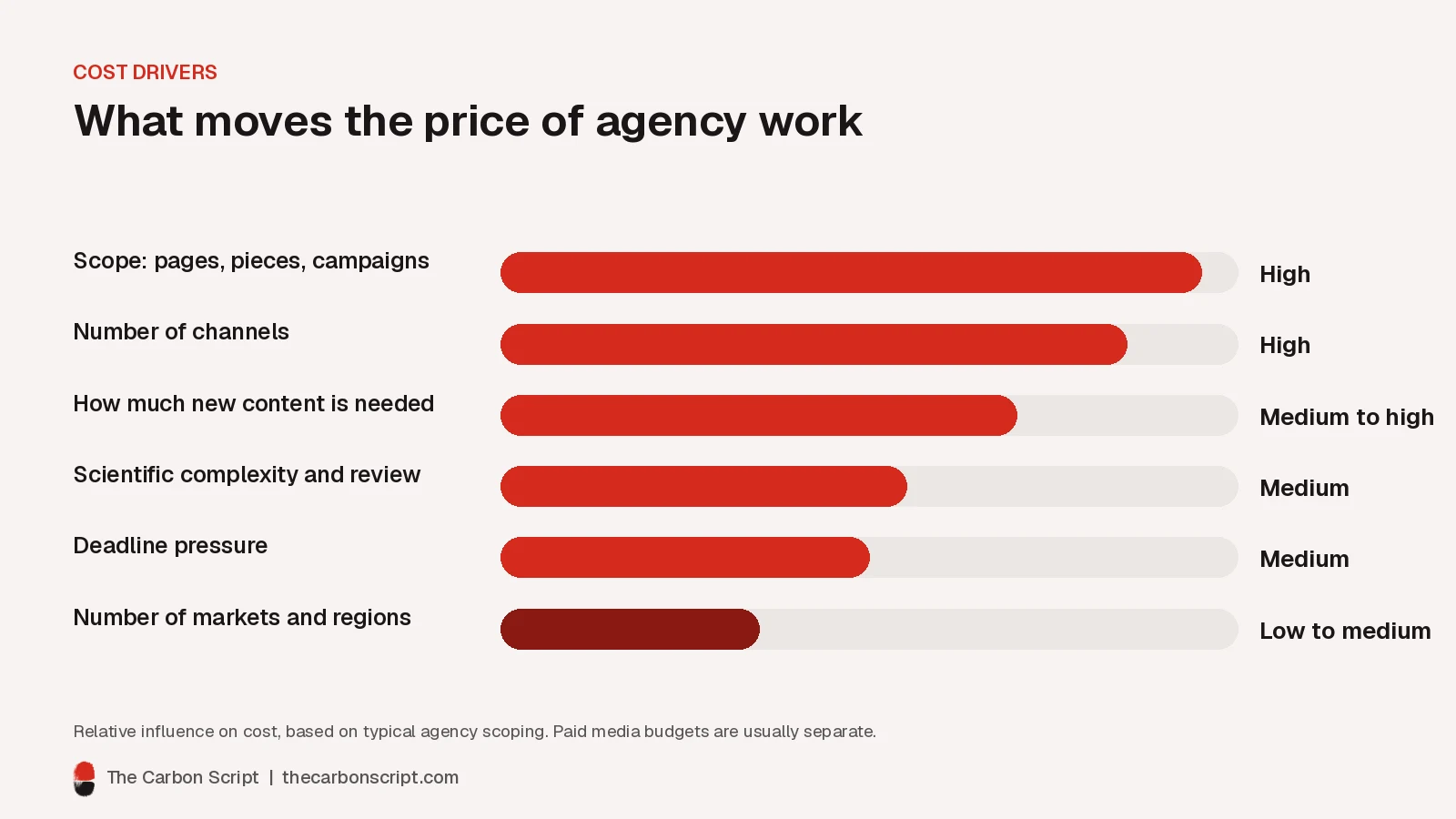
- Scope: the number of pages, articles, campaigns or assets is the biggest single factor.
- Channels: running search, LinkedIn, email and paid media together costs more than one channel, but usually performs better.
- New content: writing from scratch takes longer than refreshing what exists.
- Scientific complexity: highly technical or regulated topics need more research, expert interviews and review time.
- Speed: tight launch deadlines often need more people working in parallel.
- Markets: campaigns across the US, UK and Middle East need regional keyword research and messaging.
Agency versus an in-house hire
A single experienced marketing hire brings salary, benefits, tools and management time, and still covers only one or two skill sets. An agency or fractional team gives you several specialists, such as a strategist, writer, SEO lead and designer, for one monthly fee, without the long hiring process.
That is one reason many life science companies use outside help. In SCORR Marketing's 2024 survey of life science companies, 61% of respondents said their company contracted work through an external marketing agency that year. A hybrid model, with one internal marketing lead and a specialist agency, is common as companies grow.
Costs people forget
- Paid media budgets, which are separate from agency management fees.
- Software such as CRM, email, analytics and SEO tools, usually billed directly to you.
- Photography, video and event materials, which may be quoted separately.
- Your team's time, the cost that matters most and shows up nowhere on the invoice. An agency that gets the science right first time can be cheaper overall, even with a higher fee.
How to set your marketing budget
Start from your goal and stage, not a number.
- Preparing to raise or partner: prioritize positioning and a credible website.
- Launching a product: prioritize a launch campaign, product pages and sales materials.
- Building steady pipeline: fund content, SEO and paid media over at least two to three quarters.
Fund the foundation first, then add the channels that build demand. Many companies start with one fixed-fee project to test the relationship, then move to a retainer.
How to compare proposals fairly
- Check exactly what is included: number of pieces, pages, campaigns and review rounds.
- Ask who will do the work and what their scientific and marketing backgrounds are.
- Ask how much of your team's time the process needs.
- Ask how results will be measured and reported.
- Ask to see work for companies with similar science and buyers.
Our guide to choosing a life science marketing agency covers the full evaluation process and the red flags to watch for.
Judge value, not just price
A good proposal makes the outcome clear, not just the hours. The most useful question is not "what does it cost per month?" but "what will this produce, and how will we know it worked?". If you would like a fixed quote for your own situation, tell us what you are working on.
What to fund at each stage
Pre-seed and seed
Most budget goes to foundations: positioning, a credible website and a small amount of content that explains the science. These are usually fixed-fee projects, which keeps spending predictable while the company is still finding its focus.
Series A and early commercial
Once there is a product or service to sell, add ongoing content, SEO and LinkedIn, plus launch campaigns. Many companies move to a monthly retainer at this point, sometimes alongside a first in-house marketing hire.
Commercial scale
Budgets expand to cover paid media, events, sales enablement and multiple markets. The agency role often shifts toward specialist channels while an internal team owns strategy and coordination.
Questions to ask about any quote
- What exactly is included each month, and what would count as extra?
- How many review rounds are included?
- Who owns the work, accounts and data if we stop working together?
- Is paid media spend included or separate, and is there a management fee on it?
- What is the notice period, and is there a minimum term?
- How and how often will results be reported?
Clear answers to these questions protect you from surprises later and make proposals much easier to compare.
Frequently asked questions
How much does a biotech marketing agency cost per month?
Ongoing retainers commonly range from a few thousand dollars a month for one channel to tens of thousands for multi-channel programs. One US agency publishes a typical range of $3,000 to $30,000 a month for its life sciences clients. Ad spend is usually extra.
Is it cheaper to hire an agency or a marketing employee?
For early-stage companies, an agency or fractional team is often cheaper and faster, because you get several specialists without full-time salaries. A hybrid of one in-house lead plus an agency is common as companies grow.
How much does a life science website cost?
It depends on page count, how much new content is needed and any integrations. Get a fixed quote based on a clear sitemap rather than an hourly estimate.
What should be included in a marketing retainer?
A clear monthly scope, named team members, a review process, reporting against agreed goals and a regular planning meeting. Avoid retainers with vague deliverables.
Do you share pricing before a call?
We share a fixed quote after a short call, once we understand your goals and scope, so the number reflects what you actually need.
Sources
Want help putting this into practice?
We're a scientist-led marketing team for life science and technical companies. Tell us what you're working on and we'll show you where to start.
Book a call

