Key takeaways
- Sponsors shortlist CROs on capability fit, proof of quality and how easy you are to work with.
- Generic claims such as "quality, speed and expertise" do not differentiate. Specific capabilities, models and track record do.
- One detailed page per capability helps sponsors and search engines find exactly what you offer.
- Business development scales when marketing captures the expertise your best scientists carry.
To market a contract research organization, make it easy for sponsors to see exactly what you do, prove you do it well and start a conversation quickly. That means detailed capability pages, clear evidence of quality and experience, content that answers sponsor questions, and steady visibility in search, on LinkedIn and at the conferences your sponsors attend.
CROs sell expertise, capacity and reliability to buyers who compare carefully and rarely switch on impulse. This guide covers what sponsors look for, how to present your capabilities and which marketing channels bring in new studies.
What sponsors look for in a CRO
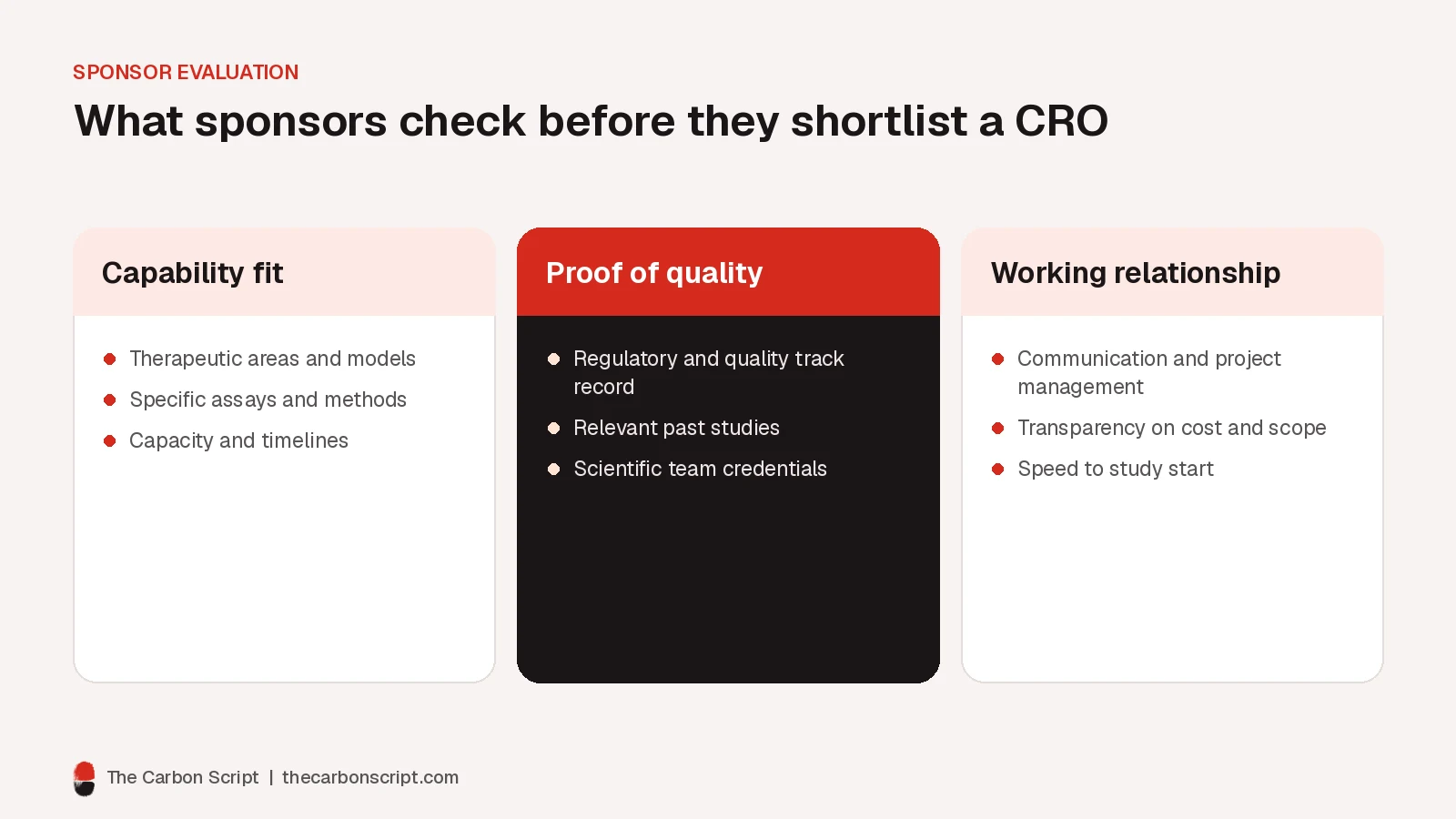
Whether the buyer is a biotech founder outsourcing a first study or a head of outsourcing at a larger company, the questions are similar. Can you run this specific study, with these models or methods, on this timeline? Have you done it before, and was the work of high quality? Will you communicate clearly and stay on budget?
Your marketing should answer those questions before a sponsor has to ask them.
How sponsors find and choose a CRO
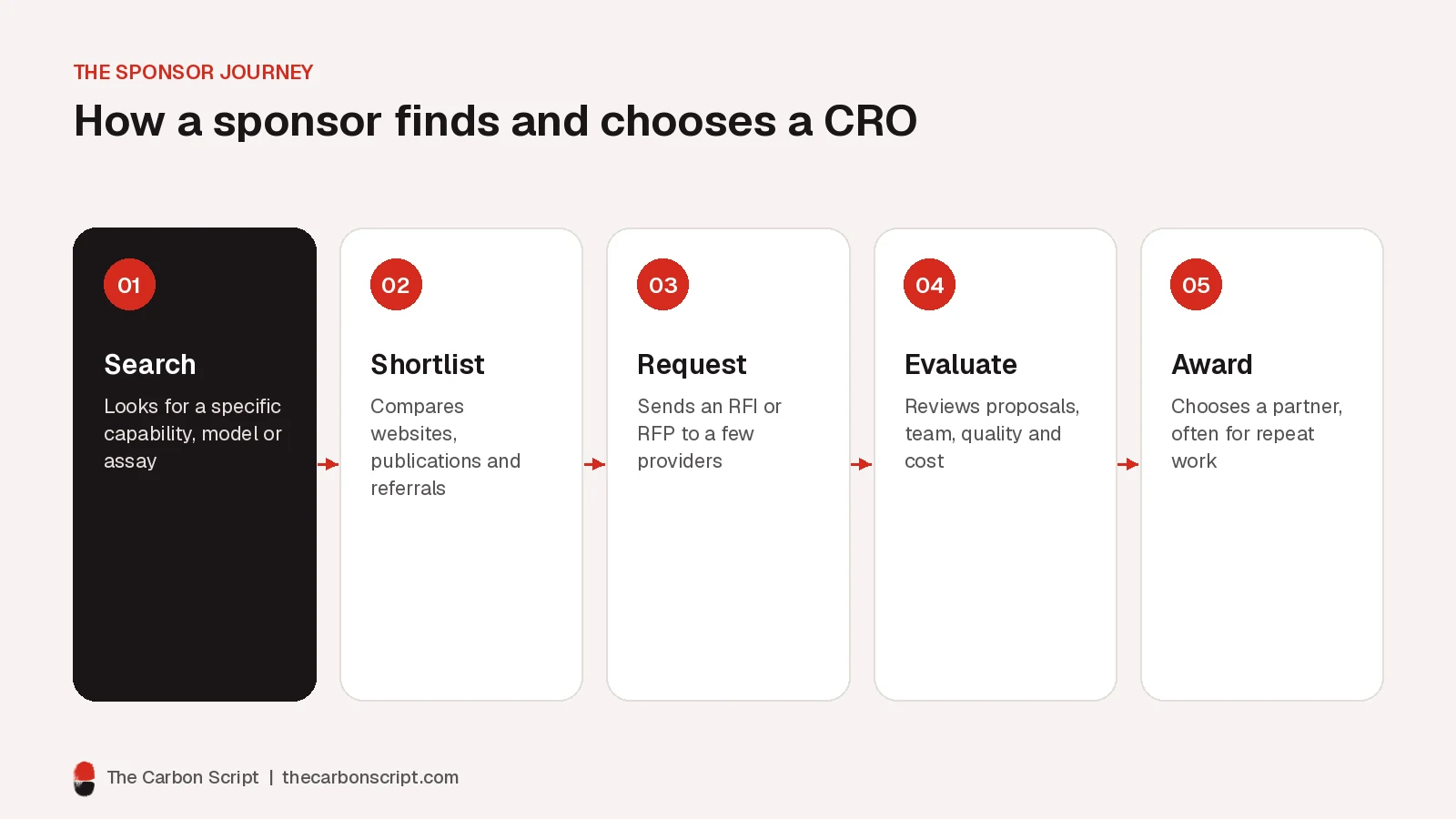
Many sponsors start with a search for a specific capability, ask colleagues for referrals and check conference exhibitor lists. They then compare websites, publications and team credentials to build a shortlist, send requests for information or proposals to a few providers, and evaluate the responses. If your website does not clearly show a capability, you may never be invited to propose.
Position your CRO beyond "quality, speed and expertise"
Almost every CRO claims quality, speed and expertise, so those words do little to set you apart. Stronger positioning is specific: the therapeutic areas you know best, the models or assays you are known for, the study types you run most often, or the type of sponsor you serve best. For example, "preclinical oncology studies for early-stage biotech companies, with study start in weeks" is far more memorable than "a full-service CRO". Our guide to positioning a science company explains the framework.
Build a CRO website that sponsors can evaluate
- One page per capability, with the scope, models or methods, typical timelines and deliverables.
- Therapeutic area pages that show your experience and the questions you can help answer.
- Quality and compliance information, such as accreditations and the standards you work to, stated precisely.
- Team pages that show the scientific experience behind the work.
- Case studies that describe the challenge, approach and outcome, anonymized where needed.
- A simple way to request a proposal, with a short form and a clear response time.
Detailed capability pages also help search engines and AI tools match your CRO to the very specific searches sponsors make.
Content that wins sponsor trust
- Method and model explainers that show depth in your specialties.
- Study design guides that help sponsors plan better studies.
- Posters and publications turned into readable web pages.
- Webinars with your scientists on topics sponsors care about.
- Regulatory and planning checklists that save sponsors time.
Content like this shows expertise and gives business development teams something useful to send. Our guide to life science content marketing covers how to produce it efficiently.
Channels that work for CROs
- Search and AI search for sponsors looking for a specific capability.
- LinkedIn for visibility with founders, outsourcing leaders and scientists, both from the company page and from your scientific leaders.
- Conferences and partnering events where sponsors meet providers.
- Email to stay in touch with past and potential sponsors between studies.
- Referrals and repeat business, supported by excellent case studies and client communication.
Support business development
In many CROs, a few senior people carry most of the sponsor relationships. Marketing can scale their expertise by turning their knowledge into content, preparing proposal-ready capability summaries, building a library of anonymized case studies and keeping the pipeline warm with useful updates. That frees business development to spend more time on qualified opportunities.
How to measure CRO marketing
- Proposal and RFI requests from the website.
- Organic visits to capability pages.
- Qualified sponsor conversations and proposals sent.
- Win rate and repeat business.
If you would like help, our CRO and CDMO marketing work starts with exactly these pages and proof points.
Frequently asked questions
How do CROs get new clients?
Mostly through referrals, conferences, search and direct business development. A clear website with detailed capability pages and case studies makes every one of those channels more effective.
What should a CRO website include?
One page per capability, therapeutic area experience, quality and compliance information, team credentials, case studies and an easy way to request a proposal.
How can a small CRO compete with large ones?
By specializing. Be the clear choice for specific models, assays, therapeutic areas or sponsor types, and show proof for each.
Is SEO worth it for a CRO?
Yes. Sponsors often search for very specific capabilities, and those low-volume searches are highly valuable when they lead to a proposal request.
Want help putting this into practice?
We're a scientist-led marketing team for life science and technical companies. Tell us what you're working on and we'll show you where to start.
Book a call

