
Key takeaways
- Growers rarely decide alone. Agronomists, crop advisers, distributors and neighbors strongly influence what gets used.
- Agriculture runs on seasons. Your marketing calendar has to match when decisions are made, not when products launch.
- Replicated, multi-location field trial data is the most persuasive asset you can have.
- Claims are regulated differently by market. In the EU, plant biostimulants have their own category under Regulation (EU) 2019/1009.
To market agtech products to growers, lead with replicated field trial results expressed in the terms growers use, such as yield, return on investment and consistency, then reach them through the people they trust: agronomists, crop advisers, distributors and other growers. Time campaigns to land before purchase decisions, which are often made months before planting, and keep every claim within the rules that apply in each market.
Agtech companies, or agri-tech companies as they are often called in the UK, frequently have strong science and a hard time explaining it to the people who use it. A grower deciding what to put on hundreds of acres wants practical proof, not mechanisms. An agronomist wants both. A distributor wants to know it will sell. This guide covers how to market to all three.
Why agtech marketing is different
Farming decisions carry real financial risk, are made once a season and are judged by results anyone can see in the field. That makes growers cautious about new products and heavily reliant on trusted advisers and peers. It also means one bad experience can follow a product for years. Agtech marketing has to earn trust slowly and deliberately.
Who influences the decision
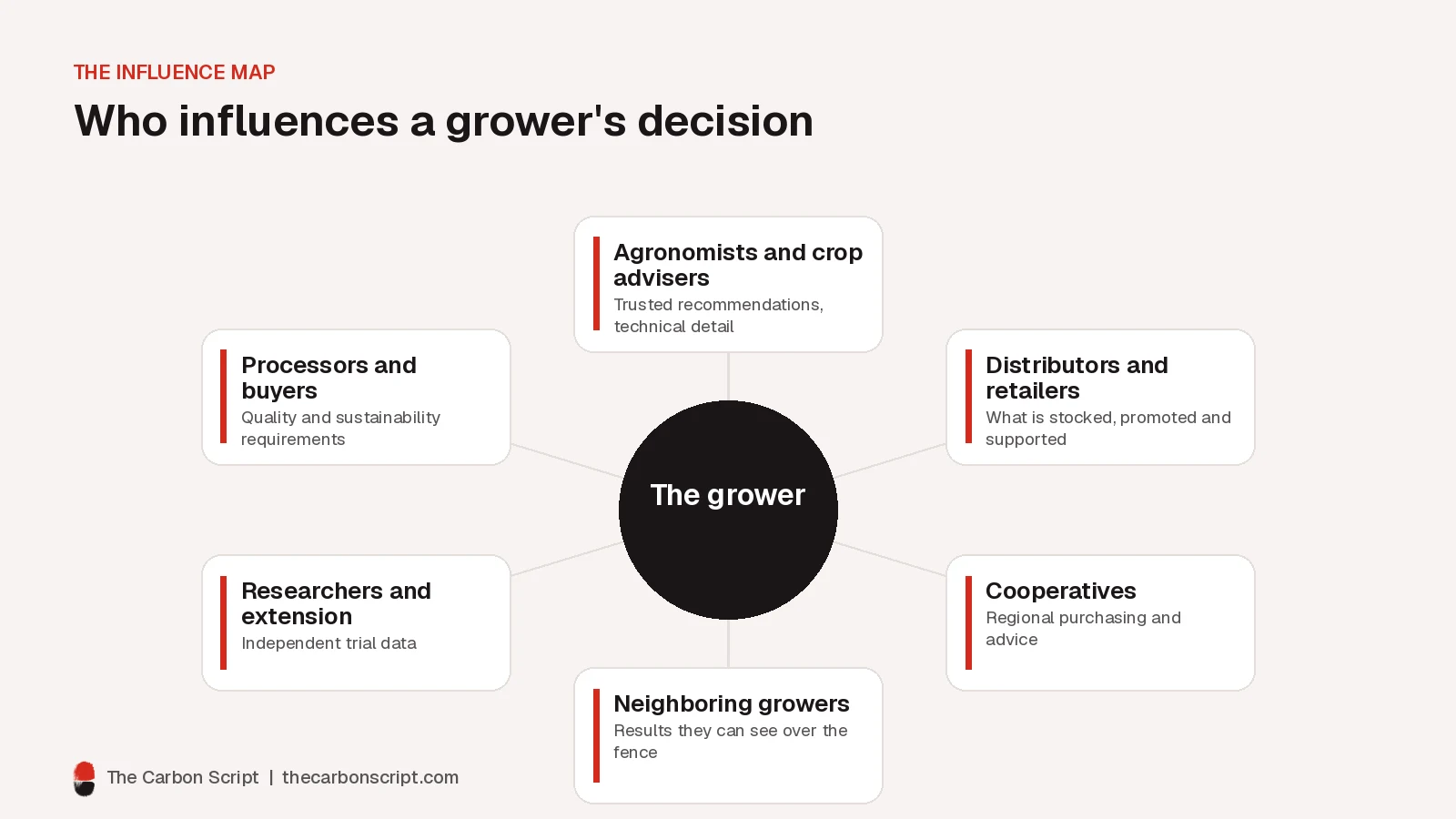
- Growers make the final call and carry the risk.
- Agronomists and crop advisers, including Certified Crop Advisers in the US, recommend products and are often the most trusted voice.
- Distributors and retailers decide what is stocked, promoted and supported.
- Cooperatives can shape purchasing and advice for whole regions.
- Researchers and extension services provide independent data growers respect.
- Processors and food companies increasingly set quality and sustainability requirements.
In controlled-environment agriculture, such as vertical farms and greenhouses, buyers look more like operations managers in any other industry, and B2B marketing approaches apply more directly.
Plan around the season
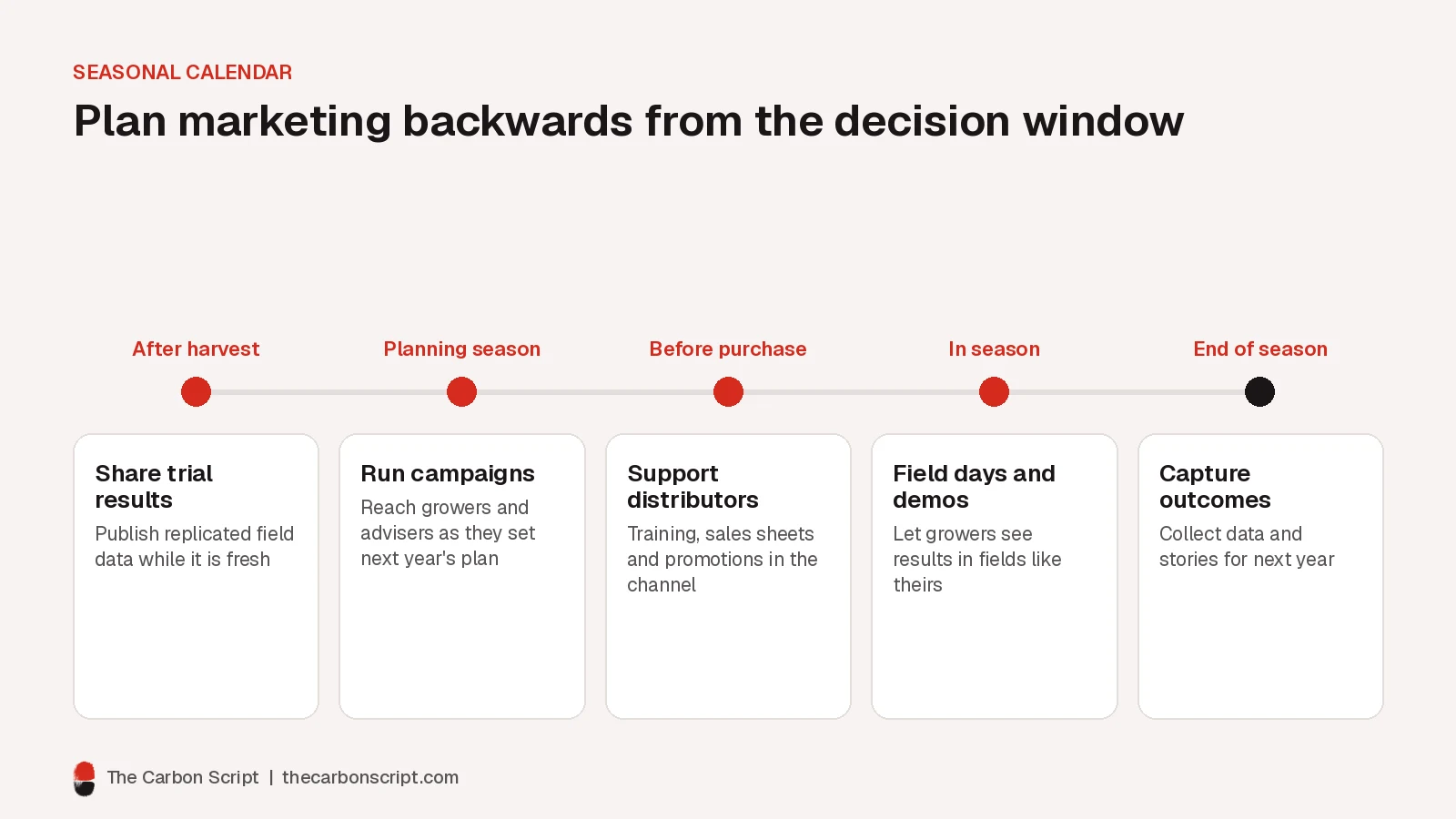
Purchasing decisions for a crop are often made well before planting. Build your calendar backwards from the key decision windows in each region, and plan trial results, case studies and campaigns to land just before them. For companies selling into several regions, including the Gulf, where growing calendars and water constraints differ, plan separate calendars.
Field trials are your best marketing
Growers trust results from fields like theirs. Replicated trials across multiple locations and seasons, ideally with independent partners such as universities or contract research organizations, are far more persuasive than lab data.
- Use growers' terms: yield per acre or hectare, return on investment, input savings and consistency.
- Show variability honestly: where it worked best, where it did not and why.
- Include conditions: crop, soil, weather, application timing and rates.
- Make it local: results from the grower's own region carry the most weight.
A grower who sees results that are slightly smaller but clearly real will trust you more than one shown a headline number that seems too good.
Get the claims right
Agricultural products are regulated differently depending on what they claim to do and where they are sold. A product presented as protecting plants from pests or disease may fall under pesticide rules, while nutrition and biostimulant claims may fall under fertilizer rules.
In the EU, Regulation (EU) 2019/1009, the Fertilising Products Regulation, applies from July 2022 and created a dedicated product function category for plant biostimulants. CE-marked biostimulants can claim effects such as improved nutrient use efficiency, tolerance to abiotic stress, quality traits and availability of confined nutrients in the soil or rhizosphere, supported by the required evidence. In the US, there is no single federal definition of a biostimulant at the time of writing; legislation has been proposed, so check the current status. Agree a claims framework with your regulatory advisers for each market before you write campaigns.
Messaging that works for each audience
- Growers: outcomes, return on investment, ease of use and local proof.
- Agronomists and advisers: mechanism, trial design, compatibility and application guidance.
- Distributors: demand, margin, training support and how you help them sell.
- Investors and partners: market size, science and evidence of adoption.
The plant science has to be accurate for advisers and simple for growers. That translation is where most agtech marketing struggles, and where a plant science background helps.
Channels that work in agriculture
- Field days and demonstration plots let growers see results for themselves.
- Trade shows and regional events remain important for relationships.
- Agricultural media, podcasts and newsletters reach growers and advisers.
- Distributor enablement, such as training, sales sheets and co-marketing, often matters more than direct marketing.
- Search and YouTube for growers researching problems and products.
- LinkedIn for advisers, distributors, investors and partners.
- Messaging apps, which are widely used in some markets for grower communities.
Content that helps
- Trial summaries with clear charts and conditions.
- Practical agronomy guides on when and how to apply products.
- Return-on-investment calculators growers can adjust for their own operation.
- Short videos from fields and from trusted advisers.
- Case studies with real growers in their own words.
- Explainers on the plant science for agronomists who want the mechanism.
Our scientific content work for agtech starts from your trial data and turns it into material for each audience.
What to measure
- Trial and demo requests.
- Distributor inquiries and dealer adoption.
- Website visits from target regions during decision windows.
- Repeat purchase rates, the strongest signal that product and marketing are both working.
Digital marketing for agtech
Your website
Make trial results easy to find, organized by crop and region. Include application guidance, product labels and safety information, a dealer or distributor locator, and a simple way to request a trial or talk to an agronomist.
Search
Growers and advisers search for specific problems, such as a disease, nutrient deficiency or stress condition, as well as product names. Content that answers those problems, with your product as one part of the solution, builds trust and visibility.
Video
Short videos from real fields, with growers and advisers explaining what they saw, are some of the most persuasive content in agriculture. Keep them practical and specific.
Marketing through distributors
Distributors and retailers often decide which products growers hear about. Help them succeed with:
- Training for their agronomists and sales staff.
- Simple sales sheets and trial summaries for their region.
- Co-branded field days and demonstration plots.
- Clear claims guidance so they stay compliant.
- Timely support during the decision window.
A distributor that can explain your product confidently is worth more than any single campaign.
Frequently asked questions
How do you market a biostimulant?
Lead with replicated field trial results in growers' terms, such as yield and return on investment, explain the mechanism clearly for agronomists, support distributors and keep claims within the regulations of each market.
What is the difference between agtech and agri-tech?
They mean the same thing. Agtech is more common in the US, and agri-tech or agritech in the UK.
When should agtech companies run campaigns?
Ahead of the decision window for each crop and region, which is often months before planting. Plan backwards from when growers and advisers make purchasing decisions.
Is digital marketing effective for reaching farmers?
Yes, especially when combined with field days, advisers and distributors. Many growers research online and watch videos, but trusted local relationships still carry a lot of weight.
How are biostimulants regulated in the EU?
Under Regulation (EU) 2019/1009, plant biostimulants have their own product function category. Products that meet the requirements can carry the CE mark and be sold across the EU market.
Sources
Want help putting this into practice?
We're a scientist-led marketing team for life science and technical companies. Tell us what you're working on and we'll show you where to start.
Book a call
