
Key takeaways
- Medical devices are bought by committees. Clinicians champion them, but value analysis, procurement and finance teams decide.
- You need two kinds of evidence: clinical evidence for the people who use the device and economic evidence for the people who pay for it.
- Use regulatory language precisely. In the US, devices that go through the 510(k) pathway are FDA cleared, not FDA approved.
- Only market the indications and claims your device is authorized for in each market.
To market a medical device, build messages and evidence for every member of the hospital buying committee, use precise regulatory language, and reach each stakeholder through the channels they trust, from conferences and key opinion leaders to search, LinkedIn and sales enablement. Clinical champions start the conversation, but value analysis committees, procurement and finance usually make the decision.
A clinician can love your device and still never get to use it. This guide explains who actually buys, what each stakeholder needs to see, and how to plan marketing that supports the whole decision rather than just the demo.
Who actually buys a medical device
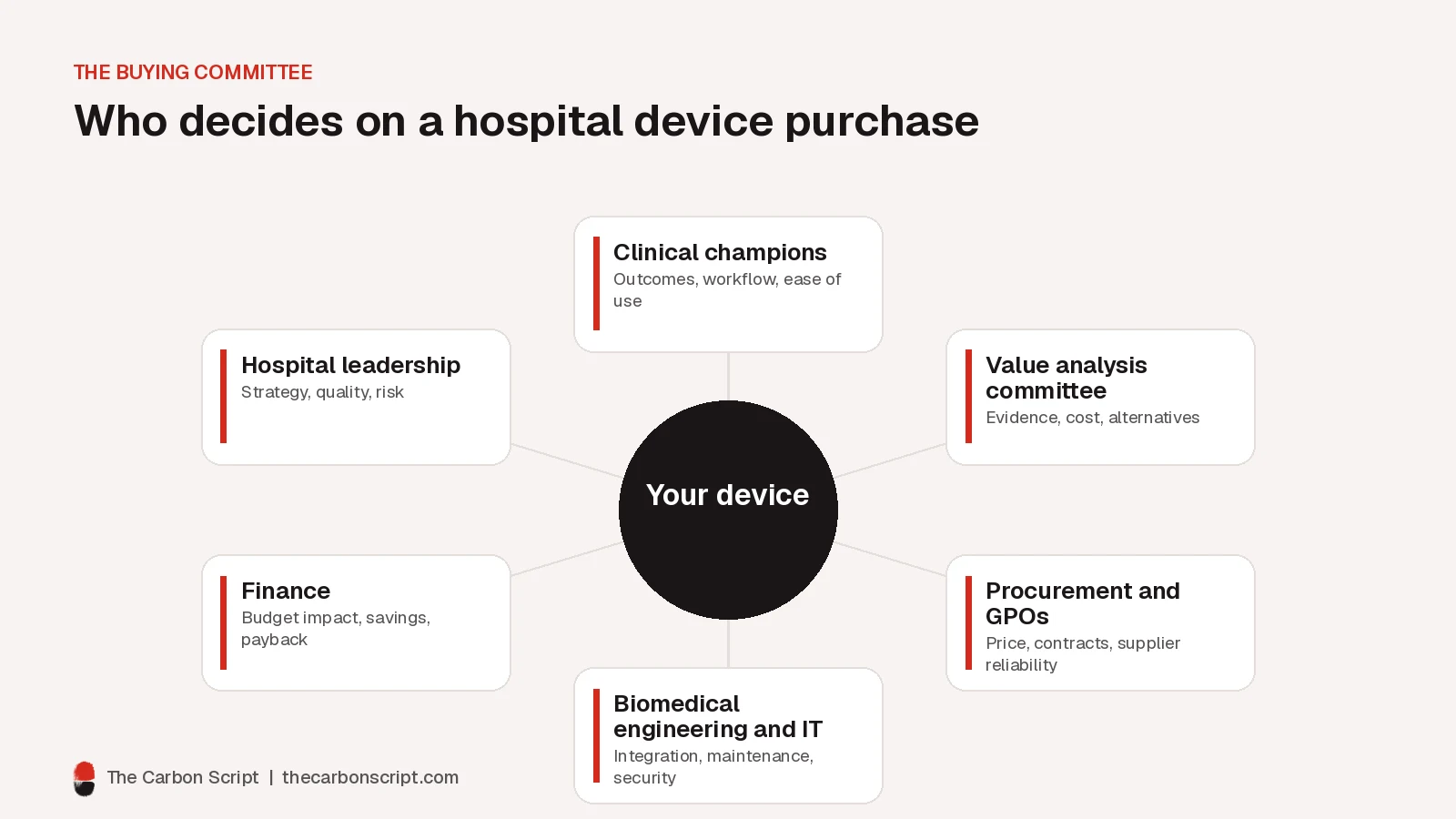
Clinical champions, such as surgeons, nurses and specialists, want to know whether the device improves outcomes and fits their workflow. Value analysis committees assess clinical evidence, cost and alternatives. Procurement and supply chain teams care about pricing, contracts and supplier reliability, and in the US many purchases go through group purchasing organizations (GPOs). Biomedical engineering and IT look at integration, maintenance and data security. Finance wants the economic case, and leadership weighs strategy, quality and risk.
How value analysis committees work
Value analysis committees became widespread in US hospitals as cost pressures grew. Research presented at ISPOR in 2015 reported that 64% of hospitals said they used some form of value analysis committee in 2012. These committees typically ask whether the device solves a documented problem, what evidence supports its safety and effectiveness, what it costs compared with alternatives and how hard it will be to adopt. Evidence requirements vary considerably between institutions, so materials that answer these questions clearly and briefly make a champion's job much easier.
Buying in the UK and the Middle East
In the UK, the NHS adds its own layers, including national procurement frameworks and, for some technologies, evaluation by NICE. In the Gulf, public hospital purchasing often runs through ministries and centralized procurement bodies, and local distributors play a significant role. Registration requirements differ by country, so plan market-specific materials.
Get the regulatory language right
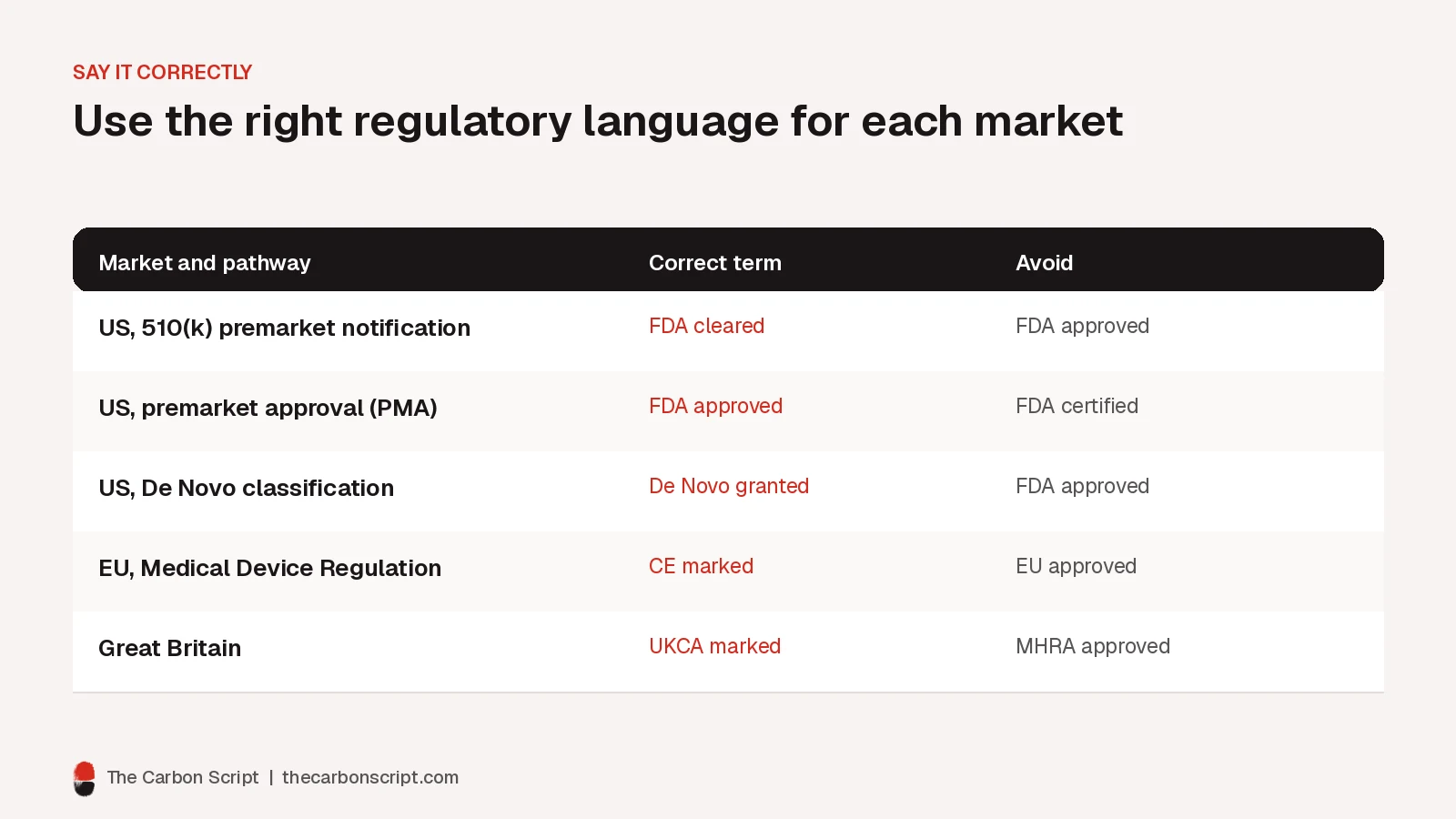
In the US, devices authorized through the 510(k) premarket notification pathway are "cleared" by the FDA, based on substantial equivalence to a legally marketed device. Higher-risk devices that go through premarket approval (PMA) are "approved". Novel lower-risk devices classified through the De Novo pathway are "granted". In Europe, devices carry CE marking under the Medical Device Regulation, and in Great Britain UKCA marking also applies.
Just as important, only promote the indications your device is cleared or approved for in each market. Build a claims library with your regulatory team and make it the single source of truth for every piece of marketing, from the website to conference booth graphics.
Clinical and economic evidence
Clinical evidence answers "does it work?". Economic evidence answers "is it worth it?". You need both.
- Clinical evidence: peer-reviewed studies, registry data, real-world outcomes and clinician experience.
- Economic evidence: reduced procedure time, shorter length of stay, fewer complications or readmissions, lower consumable costs and total cost of ownership.
- Operational evidence: training time, integration with existing systems and support commitments.
Present economic arguments clearly, show your assumptions, and give buyers tools such as a cost calculator they can adapt to their own hospital. Committees are more likely to trust numbers they can check than numbers they are simply told.
Content for each stakeholder
- Clinicians: peer-reviewed data, procedure videos, technique guides and talks from respected colleagues.
- Value analysis and procurement: one-page evidence summaries, economic models and product comparison sheets.
- Biomedical engineering and IT: technical specifications, integration documentation and security information.
- Finance and leadership: budget impact, payback period and strategic fit.
Make every piece easy to find on your website, ideally organized by role, so a champion can forward the right document to the right colleague in one click.
Channels that work in MedTech
- Medical conferences and specialty society meetings for clinical credibility and key opinion leader relationships.
- Key opinion leaders who present data, train peers and speak from experience.
- LinkedIn to reach hospital administrators, procurement leaders and clinicians professionally, organically and through ads.
- Search and AI search to capture people researching procedures, technologies and suppliers.
- Email to nurture long buying cycles.
- Sales enablement so your field team and distributors stay accurate and on message.
Planning a medical device launch
- Before clearance: build positioning, the claims library and the evidence plan, and engage key opinion leaders.
- At clearance or approval: launch the website pages, announcement, evidence summaries and sales materials.
- First six months: secure early adopters, capture outcomes and publish first case studies.
- Ongoing: build the content library, support value analysis submissions and expand to new accounts.
Make your website work as hard as your sales team
Hospital buyers increasingly research suppliers online before a sales representative ever gets a meeting. A website with clear indications, accessible evidence, honest comparisons and an easy way to request a demo or evaluation shortens that cycle. Our medical device marketing work is built around exactly this buying process.
Common medical device marketing mistakes
- Calling a cleared device "FDA approved".
- Marketing only to clinicians and ignoring procurement and finance.
- Leading with features instead of clinical and economic outcomes.
- Promoting off-label uses, even indirectly through testimonials.
- Making evidence hard to find, so champions cannot build their case.
A content plan for the first year after launch
- Launch: product pages by indication, an evidence summary, a technique guide or video, and sales materials for each stakeholder.
- Months 1 to 3: early-adopter stories, conference presentations and an economic model that hospitals can adapt.
- Months 4 to 6: first published case studies, value analysis support packs and targeted LinkedIn campaigns to administrators and procurement.
- Months 7 to 12: outcome data as it matures, comparison content, webinars with clinical champions and content for new markets.
Working with distributors and international markets
Many device companies rely on distributors, especially outside their home market. Distributors sell many products, so the ones that get attention are the ones that are easiest to explain and sell. Give them training, localized sales materials, clear claims for their market and co-marketing support.
When expanding internationally, check registration status and permitted claims country by country, adapt evidence to local care pathways and procurement processes, and translate materials professionally where needed. A claim that is acceptable in one market may not be in another.
Frequently asked questions
What is the difference between FDA cleared and FDA approved?
Cleared applies to devices authorized through the 510(k) pathway, based on substantial equivalence to a legally marketed device. Approved applies to higher-risk devices that go through premarket approval with their own safety and effectiveness evidence.
What is a value analysis committee?
A hospital group, often including clinicians, supply chain and finance, that reviews new products against clinical evidence, cost and alternatives before they are purchased.
How long is the sales cycle for medical devices?
It varies widely, from a few months for lower-cost products to well over a year for capital equipment that needs committee review and budget allocation.
Can medical device companies use LinkedIn and Google Ads?
Yes, within each platform's healthcare advertising policies and your regulatory claims framework for each market.
What should a medical device website include?
Clear indications for use, regulatory status by market, clinical and economic evidence, specifications and integration details, resources for each stakeholder and an easy way to request a demo or evaluation.
Sources
Want help putting this into practice?
We're a scientist-led marketing team for life science and technical companies. Tell us what you're working on and we'll show you where to start.
Book a call
