Key takeaways
- AI search tools build answers from sources they can find, read and trust. Google says its AI features run on the same ranking and quality systems as regular Search.
- Peer-reviewed research on generative engines found that adding citations, statistics and quotations made content up to 40% more visible in AI answers. Keyword stuffing did little.
- Science companies already own the kind of evidence AI tools reward. Most of it is locked in PDFs, posters and slide decks.
- Getting cited is mostly good science communication: clear claims, real numbers, named sources and visible experts.
To show up in AI search, life science companies need content that AI tools can crawl, understand and trust: a clear description of what you do, specific claims backed by data, cited sources, visible experts and pages that answer the questions buyers ask. The same foundations that help you rank on Google also make you more likely to be cited by ChatGPT, Perplexity, Copilot and Google's AI Overviews.
That matters because buyer behavior has shifted. A procurement lead at a contract research lab, a clinician weighing up a diagnostic or an agronomist comparing biostimulants can now ask an AI tool for a shortlist and read the answer before visiting a single vendor website. If your company is in that answer, you are in the running. If it is not, you may never find out you were considered.
The shortlist is being written before anyone visits your site
In Forrester's 2025 Buyers' Journey Survey, generative AI tools were the single most cited interaction type that B2B buyers found meaningful when researching a purchase. G2's 2025 Buyer Behavior Report found that 79% of B2B buyers say AI search has changed how they research. Both surveys cover B2B buying broadly rather than life sciences specifically, so treat them as a direction rather than a precise measure of your market.
There is an important second half to those findings. Buyers use AI as a starting point but do not trust it enough to rely on it alone. They go on to verify what it tells them with peers, experts and the vendors themselves. AI search increasingly decides who gets checked. Your website decides whether you survive the check.
How AI search decides what to cite
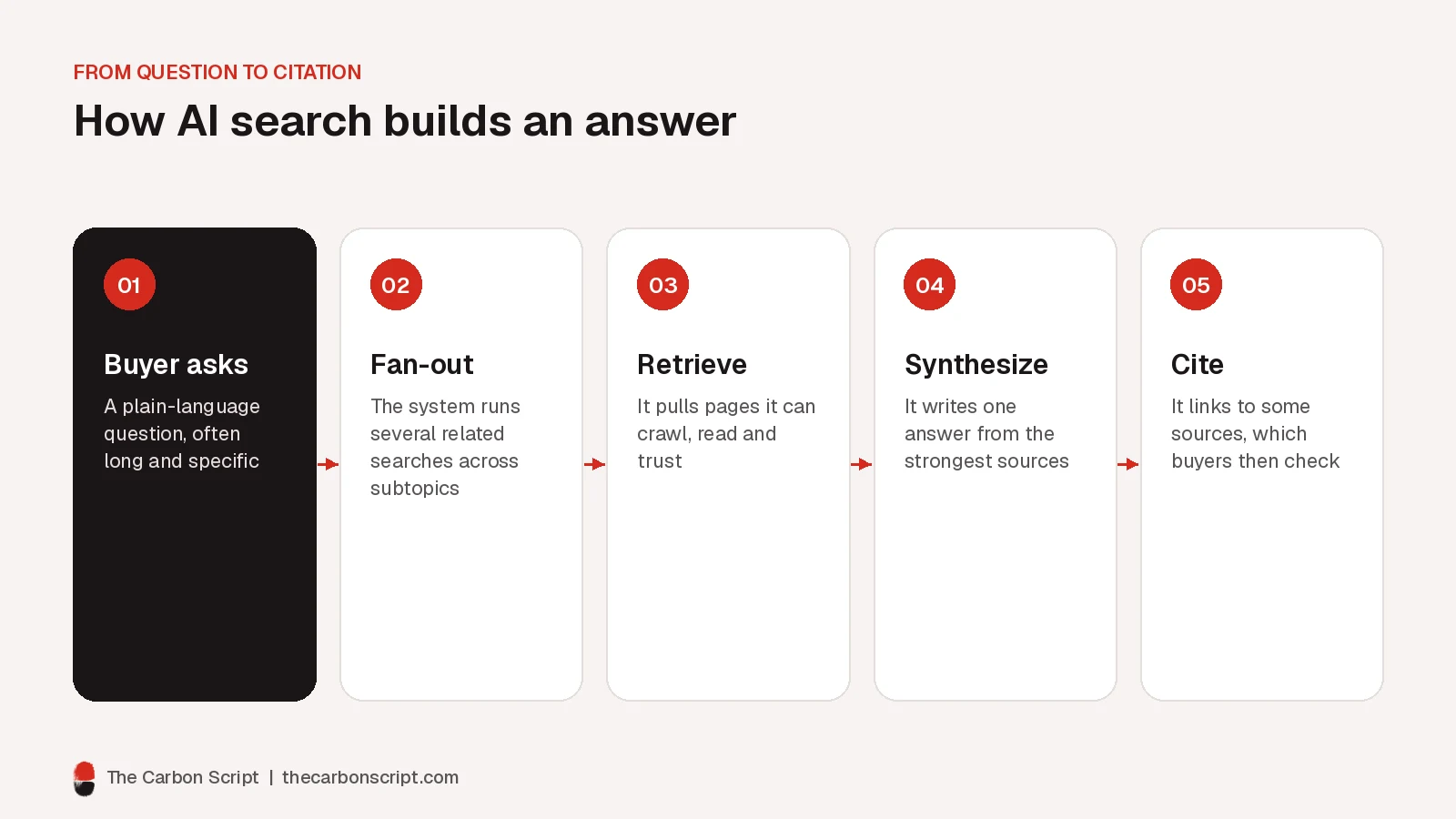
The main AI search experiences work in broadly similar ways. They interpret a question, retrieve pages that seem relevant, read them, write a single answer and link to some of the sources they used. The details differ by tool:
- Google AI Overviews and AI Mode draw on Google's search index. Google's Search Central guidance says there are no extra technical requirements and no special schema needed to appear, and describes a technique called query fan-out, where the system runs several related searches across subtopics to build one answer.
- ChatGPT search retrieves live web results and cites them. OpenAI publishes the name of the crawler it uses for search, so you can check your robots.txt allows it.
- Perplexity cites sources prominently for almost every answer, which makes it a useful tool for checking which pages AI already trusts in your category.
- Microsoft Copilot draws on Bing. Bing Webmaster Tools has added reporting on how your content appears in Copilot and AI summaries.
Query fan-out matters more than it sounds. A question such as "best qPCR kit for low-input samples" may pull from pages about sensitivity, sample preparation, workflow time and independent comparisons, not just from the page that ranks for that exact phrase. Companies that explain the whole problem in depth have more chances to be picked up than companies with one polished product page.
What the research says
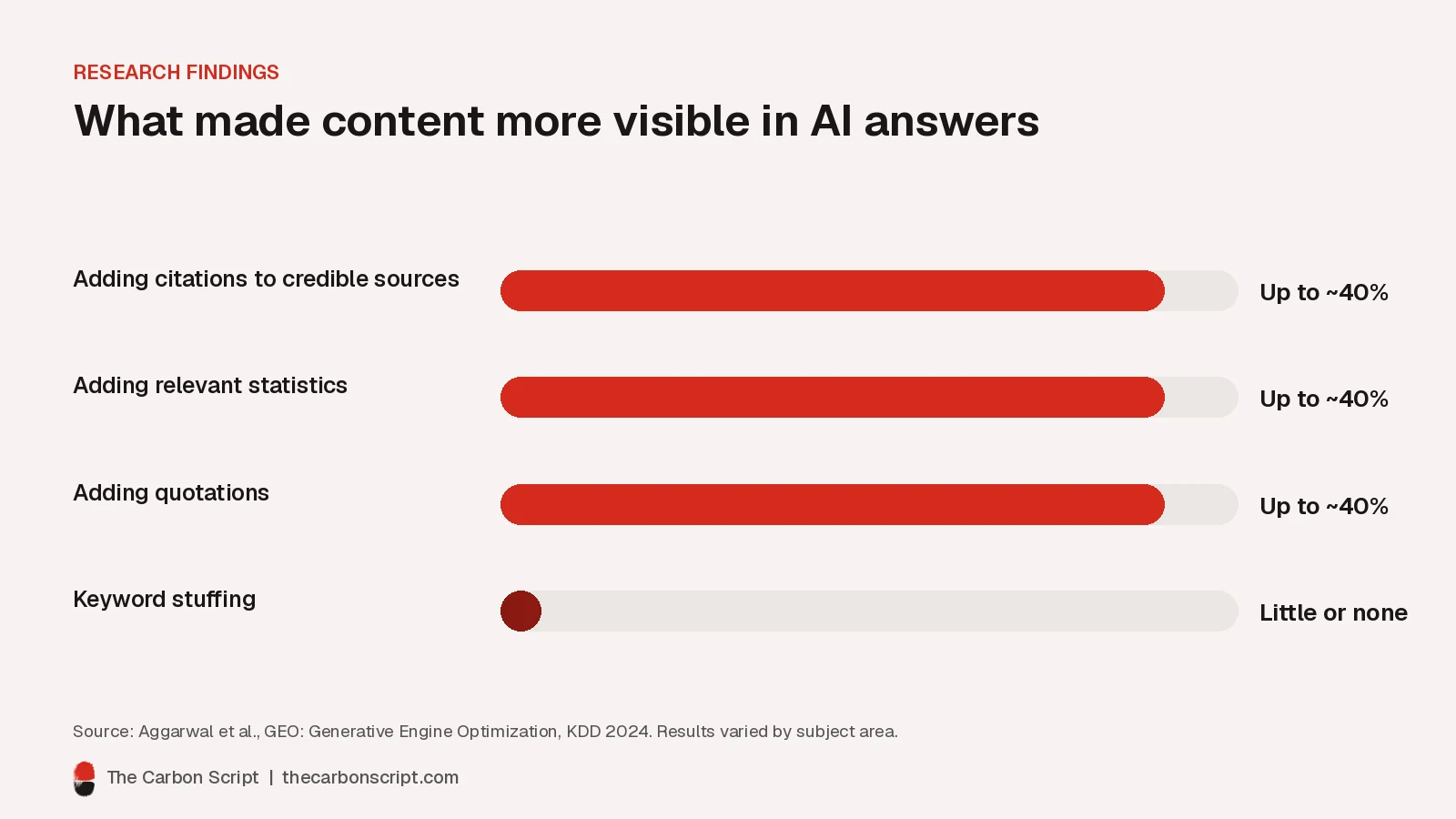
The most useful evidence so far comes from "GEO: Generative Engine Optimization", a study by researchers at Princeton and IIT Delhi presented at KDD 2024. The team made controlled changes to source pages and measured how visible each page became in AI-generated answers. Adding citations to credible sources, adding relevant quotations and adding statistics each made content significantly more visible, by up to 40% in their benchmark. Keyword stuffing offered little to no improvement, and what worked best varied by subject area.
Read that list again and it looks a lot like what a good peer reviewer asks for: make a specific claim, back it with data, and show where it came from.
Why science companies have an advantage, and often waste it
Evidence is the one thing life science companies have in abundance: validation studies, trial data, peer-reviewed papers, application notes, regulatory clearances and field results. It is exactly the material AI tools look for.
The problem is where that evidence lives. It sits in gated PDFs, conference posters, investor decks and supplementary files, or it is written so densely that neither a buyer nor a model can pull a clear claim out of it. Meanwhile the homepage says something like "innovative solutions for a healthier tomorrow". An AI tool cannot cite that, because it does not say anything.
There is a second risk that gets less attention. If AI tools cannot find a clear, accurate description of your science, they will use someone else's: a competitor's comparison page, an old press release or a forum thread. Being described wrongly can be worse than not being described at all, especially in regulated categories.
Seven ways to make your science easy for AI to cite
1. Say what you are in one plain sentence
Every AI answer starts with the model deciding what each company actually does. Put one clear sentence on your homepage and key pages that covers what you make, who it is for and what makes it different. For example: "We make a rapid molecular assay that detects antimicrobial resistance genes in under an hour, for hospital microbiology labs." Use the same description everywhere your company appears, from LinkedIn to industry directories, so every source agrees.
2. Turn your PDFs into pages
Keep the PDF as a download, but publish the key findings as a normal web page with proper headings: the question, the method in brief, the result and what it means for the buyer. Pages are easier to crawl, quote and link to than files.
3. Answer the questions buyers actually ask
Collect real questions from sales calls, support tickets and conference conversations. Write a page or section for each one and answer it directly in the first two sentences before going into detail. Questions like "how does it compare with the standard method?" and "what sample types does it work with?" are worth more than another page of features.
4. Put a number next to every claim
"Improves yield" is an opinion. "Increased yield by 12% across 18 field trials in three regions" is a claim someone can check, and a model can cite. (Those figures are illustrative.) Include sample sizes, conditions and timeframes, and link to the full data.
5. Cite your sources, including your own papers
Link to the DOI, the PubMed record, the registry entry or the regulatory database listing behind each important claim. A short reference list reassures expert readers and signals to AI tools that the claim is grounded in something outside your marketing.
6. Show the scientists behind it
Put names, roles and credentials on your content, add "reviewed by" lines to technical pages and explain your team's expertise specifically on your About page. Google's guidance on helpful content emphasizes experience, expertise, authoritativeness and trust, and the same signals help AI tools decide which sources to rely on.
7. Earn mentions beyond your own website
AI answers rarely rely on a company's own site alone. They draw on trade publications, society newsletters, conference proceedings, distributor and partner pages, review platforms and podcasts. Every independent, accurate mention is another source an AI tool can use.
The technical basics
- Crawlability: important pages should load without logins or heavy scripts, and your robots.txt should not block the crawlers AI search tools use. Google's AI features use Googlebot; the separate Google-Extended setting controls use in Gemini models, not Search.
- Structured data: Organization, Product, Article and FAQ markup help machines understand your pages, as long as the markup matches what is visible.
- Bing indexing: verify your site in Bing Webmaster Tools, because Copilot and several other AI experiences draw on Bing.
- Speed and mobile: fast, readable pages help both people and crawlers.
What to avoid
Do not write for robots. Keyword stuffing did not help in the research above, and it makes your content worse for the people who still have to say yes. Do not gate everything: if your best evidence sits behind a form, AI tools cannot see it. Most importantly, do not overclaim. AI tools may repeat what you say almost word for word to a buyer who knows the field well, and in regulated categories an exaggerated claim can become a compliance problem.
How to check where you stand today
- Write down 15 questions your buyers might ask an AI tool, covering your category, the problem you solve, comparisons and "best option for" questions.
- Run each one in ChatGPT, Perplexity, Copilot and Google, noting whether an AI Overview or AI Mode answer appears.
- Record whether you are mentioned, whether the description is accurate, which competitors appear and which sources are cited.
- Repeat monthly. Answers vary from run to run, so look for patterns rather than single results.
The cited sources are often the most useful part. They show which publications, directories and pages AI tools already trust in your space, which tells you where to earn your next mention. If you would like an outside view, our SEO and AI search service starts with exactly this audit.
How to measure AI search visibility
- Mentions and accuracy from your monthly question set.
- Referral traffic from AI tools in your analytics, which many now pass as identifiable referrers.
- Google Search Console, where traffic from AI features is included in Web search reporting.
- Bing Webmaster Tools reporting on Copilot and AI summary citations.
- Sales conversations where prospects say they found you through an AI tool.
Frequently asked questions
What is AI search optimization?
It is the work of making sure AI-powered search tools, such as ChatGPT, Perplexity, Copilot and Google's AI Overviews, can find your content, understand it and trust it enough to mention your company in their answers.
Is generative engine optimization (GEO) different from SEO?
They overlap heavily. Google says its AI features rely on the same ranking and quality systems as regular Search, so strong SEO is the foundation. GEO adds a sharper focus on making individual claims easy to quote: clear statements, statistics, citations and named experts.
Do we need special schema markup for AI Overviews?
No. Google says no special structured data is required for its AI features. Standard markup such as Organization, Product, Article and FAQ is still worth having, as long as it matches what is visible on the page.
How long does it take to start appearing in AI answers?
It varies, and nobody can guarantee placement. Pages first need to be crawled and indexed, and authority builds through content and outside mentions. Most companies should expect changes over months rather than days.
What if an AI tool describes our product incorrectly?
Publish a clear, accurate description and the evidence behind it on your own site, then correct inaccurate third-party sources such as old listings or distributor pages. Keep monitoring, because answers change as their sources change.
Should we block AI crawlers?
If you want to appear in AI answers, do not block the crawlers used for AI search. You can make separate decisions about crawlers used only for model training.
Sources
Want help putting this into practice?
We're a scientist-led marketing team for life science and technical companies. Tell us what you're working on and we'll show you where to start.
Book a call