
Key takeaways
- RUO is an exemption that depends on intended use, and regulators read intended use from all of your marketing, not just the label.
- Clinical performance claims, diagnostic search terms and selling mainly to labs that only test patients all signal diagnostic intent.
- You can still publish hard analytical data, research applications and disease research areas.
- Keep a single claims library and make the website, ads, sales and support all draw from it.
To market a research use only (RUO) product safely, make every part of your marketing consistent with research use: the label statement, product pages, search ads, sales targeting and technical support. Regulators judge a product's intended use from everything a company says and does around it, not from the label alone. Disease-specific performance claims, clinical language and selling mainly to labs that only run patient testing can turn an RUO product into an unapproved diagnostic in their eyes, whatever the label says.
RUO labeling is how most research tools reach the market: antibodies, assay kits, sequencing panels, mass spectrometry reagents and the instruments that run them. The difficulty is that the most persuasive thing you can tell a buyer is often what the product means for a disease, and that is exactly where research marketing starts to sound like diagnostic marketing. This guide sets out where the line sits in the US and the EU, the habits that cross it, and how to write pages and train teams so you can sell confidently on the right side of it.
What "research use only" actually means
In the US, RUO is an exemption, not a product category. Under 21 CFR 809.10(c)(2)(i), an in vitro diagnostic product that is in the laboratory research phase of development, and not represented as an effective diagnostic, can be shipped without the full labeling and premarket requirements as long as all of its labeling carries, prominently, the statement "For Research Use Only. Not for use in diagnostic procedures." A related exemption covers products in clinical investigation, labeled "For Investigational Use Only. The performance characteristics of this product have not been established."
FDA's 2013 guidance on distributing RUO and IUO products makes the condition explicit: RUO labeling has to be consistent with what the manufacturer actually intends the product to be used for. The statement is a warning to users, and FDA has signaled that anything a company does to undercut that warning can be a problem.
In the EU, the In Vitro Diagnostic Medical Devices Regulation, (EU) 2017/746, excludes products for general laboratory use and research-use-only products, unless the manufacturer specifically intends them for in vitro diagnostic examination. The Medical Device Coordination Group's 2024 guidance on qualifying IVDs, MDCG 2024-11, adds that a research-use-only product cannot be intended by its manufacturer for a medical purpose. Excluded from the IVDR does not mean unregulated, though. Chemical safety labeling, product safety and other rules still apply.
One misunderstanding worth clearing up early: RUO is not a quality tier. An RUO reagent can be made to a very high standard. The label describes intended use, not how good the product is.
How regulators decide what you really intend
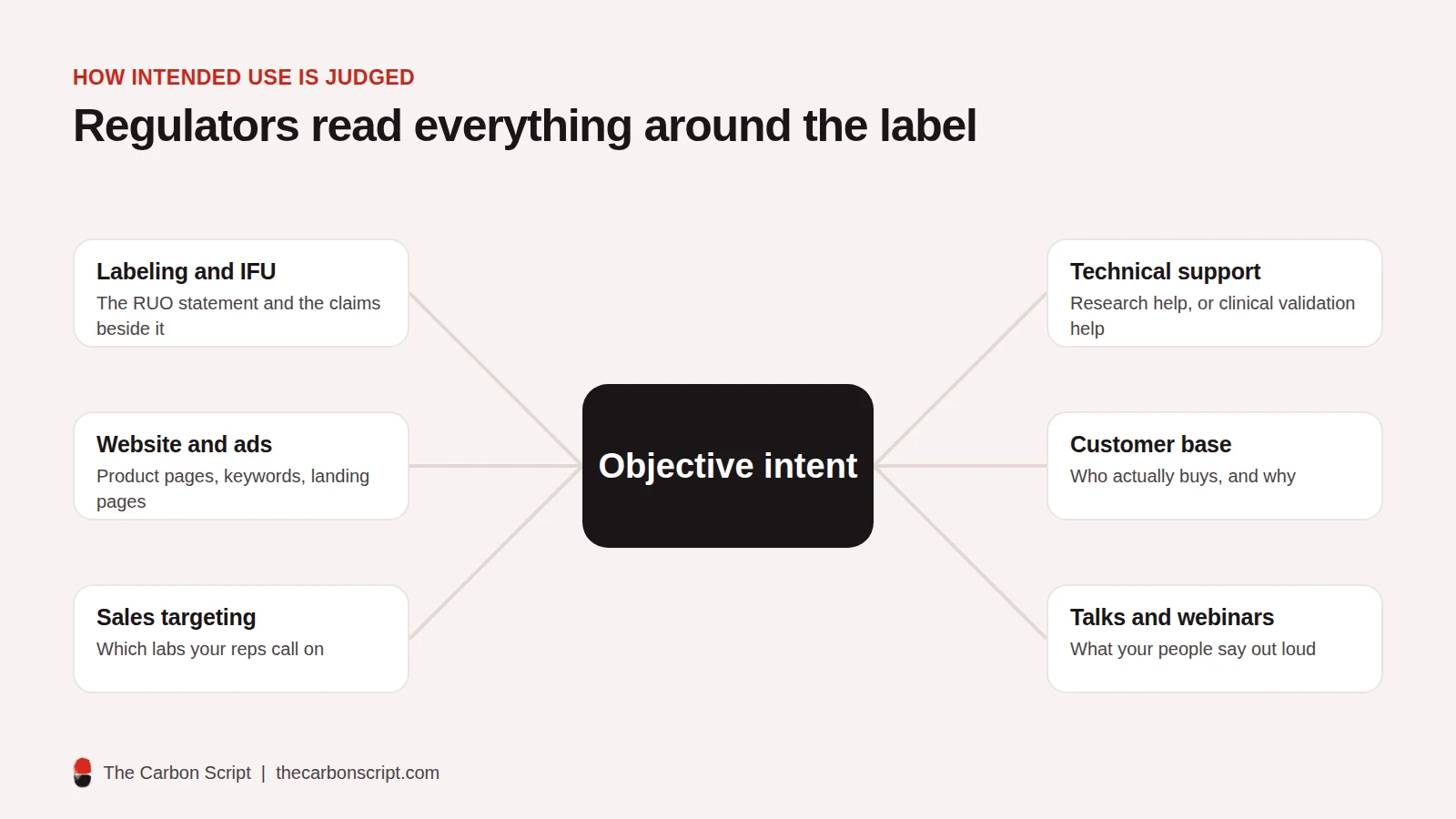
US law judges intended use by the "objective intent" of the people responsible for the product, which can be shown by labeling claims, advertising, oral or written statements by the company and its representatives, and the circumstances of distribution. FDA's RUO guidance applies this to research products and says the totality of the circumstances counts.
The guidance gives examples of what that looks like in practice. A manufacturer that sells only RUO products but whose sales force routinely calls on clinical laboratories that do not do research may be showing that it intends clinical use. So may providing specialized technical support, such as help performing clinical validation, to clinical labs.
Enforcement follows the same logic. In a 2024 warning letter, FDA cited a manufacturer whose RUO-labeled panels had been delivered to clinical settings and described in customer communications in clinical terms, and concluded that the company's RUO disclaimers were inconsistent with the evidence. The label said research. Everything around it said diagnostics.
Marketing habits that signal diagnostic intent
Most RUO problems are not deliberate. They come from a product page borrowed from an IVD sibling, an ad campaign optimized for clicks, or a sales team chasing the fastest-growing customer segment. These are the habits to look for.
| Where | Red flag | Why it reads as diagnostic |
|---|---|---|
| Product pages | Clinical sensitivity and specificity, "detects", "diagnoses" or "screens for" a disease, "patient results" | Clinical performance claims are what diagnostics make, and RUO products have not been shown to deliver them |
| Search and social ads | Bidding on "[disease] test" or "diagnostic kit for [condition]" | You are buying the attention of people looking for a diagnostic |
| Sales targeting | Target lists built from hospital and reference labs with no research programs | FDA's guidance names this pattern directly |
| Technical support | Help with clinical validation, accreditation inspections or patient report templates | Supports diagnostic use rather than research |
| Pricing and documentation | Per-patient pricing, reimbursement or billing code guidance | Only makes sense for clinical testing |
| Content and events | Case studies of clinicians using results for treatment decisions; webinars on "adding this to your clinical workflow" | Shows the use you are promoting, in your own voice |
| Comparisons | "As accurate as" a cleared or approved diagnostic | Positions the product as a substitute for a regulated test |
The comparison row deserves extra care. In congressional testimony when the guidance was issued, FDA's device center director said the agency's actions against RUO products promoted for clinical diagnosis had come where a cleared or approved test existed for the same use.
What you can say, and how to say it
None of this means RUO marketing has to be vague. Researchers want hard numbers, and you can give them, framed as research performance.
- Analytical performance: limit of detection, linearity, precision, input range and the sample and matrix types tested, measured on reference materials or research samples.
- Research applications: discovery, translational research, method development, pharmaceutical R&D, biobank and cohort studies.
- Research areas: "for research into colorectal cancer biomarkers" describes a research field. "Detects colorectal cancer" describes a diagnostic claim. The disease can appear; the claim cannot.
- Publications: list peer-reviewed research that used your product. Do not restate clinical conclusions from those papers as your own promises.
- Workflow fit: compatible instruments, throughput, automation and data formats.
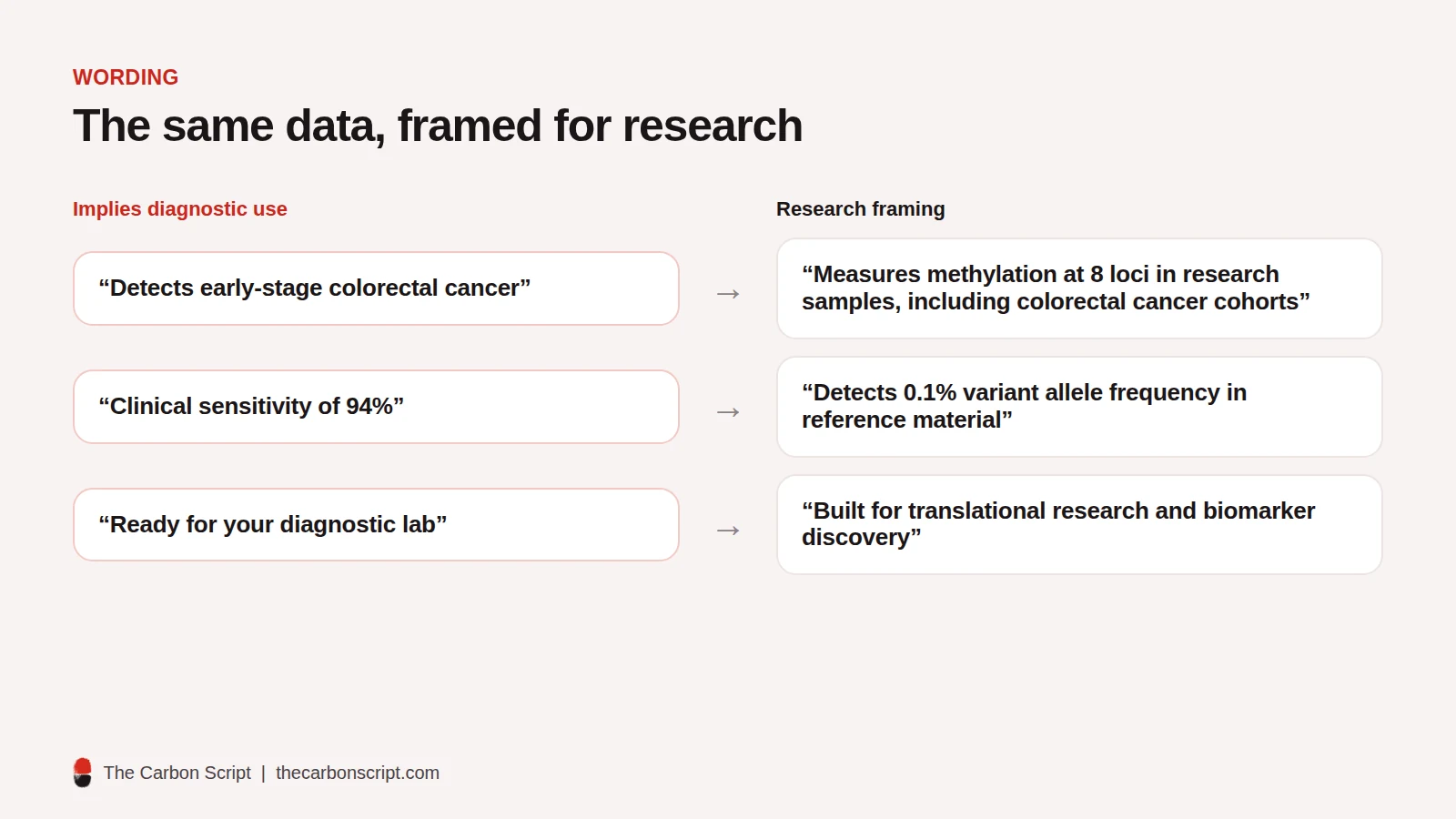
Use the rewrites as patterns, not templates. If a sentence only makes sense to someone deciding something about a patient, it does not belong on an RUO page.
Build the website for RUO
Your website is the part of your marketing a regulator, a competitor or an AI assistant is most likely to read, so it is where consistency matters most.
- Put the RUO statement where the claims are. On every product page near the specifications, on datasheets and instructions, on quotes and order confirmations, not only in a footer.
- Separate RUO and diagnostic lines. If you also sell cleared or CE-marked IVDs, give them separate pages, names and navigation, and never let a clinical claim from one bleed onto the other.
- Write metadata in research language. Page titles, meta descriptions, image alt text and structured data are what search engines and AI assistants summarize. If your meta description says "detects cancer", that is what an AI answer may repeat about your product.
- Qualify on forms. Ask for institution type and intended application on quote and sample forms, and route clinical inquiries to your IVD team or decline them.
- Use negative keywords. Exclude terms such as diagnosis, screening, patient and "test for" from search campaigns.
- Keep a claims library. One approved list of performance statements, owned by regulatory, that product pages, decks and webinars all draw from.
Sales and support rules that hold up
The website sets the story. The sales and support teams decide whether the evidence matches it.
- Define your market in writing: which customer types you sell RUO products to, recorded in your CRM so you can see the mix.
- Train and script: give reps clear lists of what they can say about performance and what they cannot, and make it part of onboarding.
- Treat customer certifications as one control, not a shield: FDA's guidance discusses programs where customers certify research use. A signed form does not outweigh a sales pattern that points the other way.
- Draw the support line: support research applications fully; decline help with clinical validation or accreditation for diagnostic use.
- Review the customer mix: if a growing share of a product's volume goes to labs that only do patient testing, that is a signal to review, not just a sales win.
Free download. The pre-launch marketing checklist includes a claims review step to run before any product page goes live.
If the product is heading toward diagnostics
Many RUO products are the first stage of a future diagnostic. That path is legitimate, but it creates the riskiest marketing period, when the team is excited about clinical potential and the product is still RUO.
- Keep research and future clinical messaging apart. Talking about clinical performance before clearance is promotion of an unapproved device, whatever the current label says.
- Plan the message migration: when the IVD version launches, it should get its own name, pages and claims, rather than the RUO page quietly changing its wording.
- In the EU, studies that generate clinical performance data run under the IVDR's own rules for performance studies.
Laboratories that develop their own tests sometimes use RUO components, and the regulatory picture for laboratory-developed tests in the US shifted again when a federal court vacated FDA's laboratory-developed test rule in March 2025. That ruling concerns how labs are regulated. It does not change a manufacturer's obligation to market an RUO product consistently with research use.
Content that sells RUO products without crossing the line
- Application notes built on research studies, with full methods.
- Protocols and troubleshooting guides, which researchers search for and AI assistants cite.
- Technical webinars with research customers, reviewed against your claims library before they air.
- Method comparisons on reference materials and research samples.
- A publication library filterable by application and research area.
- Data packages for core facilities, who evaluate products on behalf of many labs.
Scientific content written by people who understand both the assay and the rules is what keeps this work fast. It is a large part of our life science tools and diagnostics work, and our guide to marketing lab products to scientists covers the evidence researchers look for before they switch.
A note on scope. This guide explains how marketing practices relate to RUO rules. It is not legal or regulatory advice. Have your regulatory team or counsel review claims, and check current FDA and EU guidance before launch.
Frequently asked questions
What does "for research use only" mean?
It means the manufacturer intends the product for research, not for diagnosing or treating patients. In the US, RUO products must carry the statement "For Research Use Only. Not for use in diagnostic procedures." on all labeling, and the company's marketing and distribution must be consistent with that intended use.
Can RUO products be sold to clinical laboratories?
Many clinical and hospital laboratories also do research, and selling to them for research use is common. The risk comes when a company targets labs that only do patient testing, or supports them in using the product for diagnosis. FDA's guidance names routine sales calls to clinical labs that do not do research as a sign of clinical intent.
Can I mention a disease on an RUO product page?
You can describe a research area, for example "for research into colorectal cancer biomarkers". Avoid clinical performance claims about the disease, such as "detects colorectal cancer" or clinical sensitivity and specificity.
What is the difference between RUO, IUO and IVD?
RUO products are for research and carry the RUO statement. IUO products are being tested in clinical investigations before full marketing and carry an investigational use statement. IVDs are diagnostic products that have met the regulatory requirements for clinical use, such as FDA clearance or approval in the US, or CE marking under the IVDR in the EU.
Do RUO products need CE marking under the IVDR?
No. The IVDR excludes research-use-only products unless the manufacturer specifically intends them for in vitro diagnostic examination. They may still fall under other EU rules, such as chemical safety labeling.
Can laboratories use RUO reagents in laboratory-developed tests?
Laboratories sometimes use RUO components in tests they develop and validate themselves, under their own responsibility. Manufacturers should not promote RUO products for that clinical use, and should not provide clinical validation support for it.
Sources
- 21 CFR 809.10: labeling for in vitro diagnostic products
- 21 CFR 801.4: meaning of intended uses
- Federal Register, November 25, 2013: FDA guidance on IVD products labeled RUO or IUO
- RAPS: FDA's final RUO and IUO guidance
- Hyman, Phelps & McNamara: CDRH final guidance on RUO and IUO products
- Discoveries in Health Policy: FDA warning letter on RUO-labeled products, 2024
- Regulation (EU) 2017/746 on in vitro diagnostic medical devices
- Johner Institute: research use only products under the IVDR and MDCG 2024-11
Unsure what your product pages imply?
We write RUO product pages and claims libraries that sell to researchers and stay consistent with research use.


