Key takeaways
- Scientists buy on evidence they can check: validation in their application, citations, protocols and peers.
- Your job is to lower the risk of switching, with samples, side-by-side protocols and guarantees.
- Product pages should match how scientists search and keep datasheets and protocols ungated.
- Measure sample-to-order conversion, reorders and citations, not just traffic.
To market lab products to scientists, lower the risk of switching. Researchers choose reagents, consumables and instruments on evidence they can check for themselves: validation data in their own application, citations, protocols and what colleagues say. So the work is to publish that evidence openly on fast, specific product pages, make trying the product easy with samples and side-by-side protocols, reach the whole buying group from graduate students to procurement, and measure whether trials turn into reorders.
Anyone who has lost three weeks to an antibody that did not work in their hands understands the buyer here. A scientist is not choosing between two products. They are choosing between a known result and a risk to an experiment, a deadline and sometimes a paper. Most lab product marketing talks about the product. The marketing that works talks about that risk.
Why scientists are hard to win and easy to keep
Switching a reagent is expensive in ways that never appear on an invoice. A new antibody or kit has to be re-optimized and re-validated, and results have to stay comparable with data the lab has already collected. That is why labs keep using products that work, and why a new supplier's first job is to make switching feel safe.
Scientists are not loyal to one vendor, though. A 2026 survey of antibody buyers by Science and Medicine Group found that researchers use an average of 5.6 antibody suppliers at the same time. There is room for a new supplier in almost every lab, one product and one application at a time.
Their skepticism is also earned. In a 2026 preprint analyzing 614 antibodies characterized with knockout controls, 97 of them, 15.8 percent, failed in every application tested. The same study found that antibody choice is strongly influenced by social factors such as previous lab use and peer recommendation, while systematic evaluation of performance data is limited. Clear, honest data is a real advantage in a market where much of it is missing.
Who is in the buying group
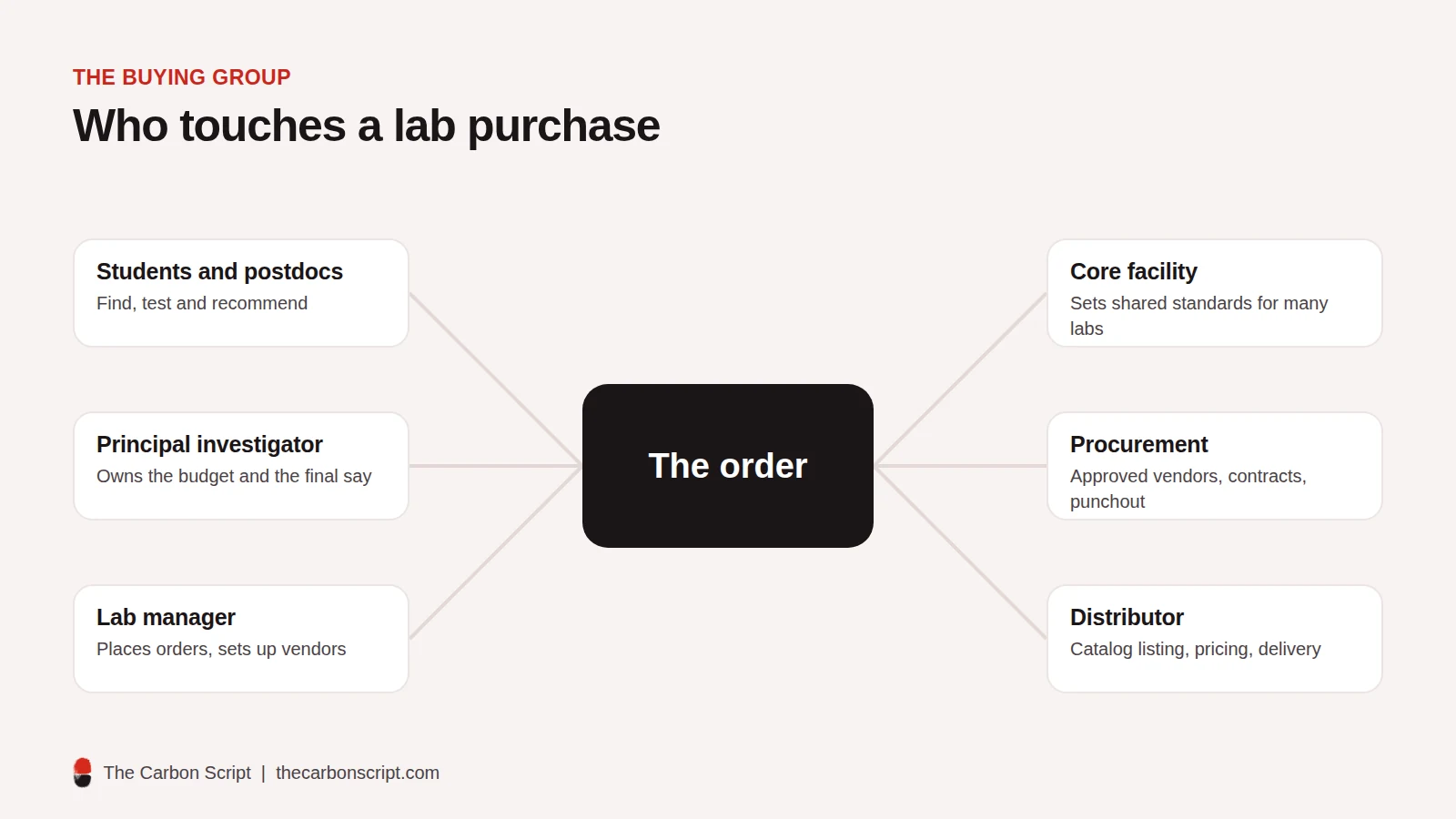
- Graduate students and postdocs do most of the searching and testing. Early-career scientists shape shortlists, but they rarely sign the purchase order. Give them protocols, data and an easy way to request a sample.
- The principal investigator owns the budget and the risk to the lab's work. They care about reproducibility, publication risk and whether the change is worth it.
- The lab manager places orders, sets up vendors and manages stock. Price, delivery times and how easy you are to buy from matter most here.
- Core facility managers choose instruments and standard reagents on behalf of many labs. Winning one core can mean dozens of users.
- Procurement controls approved vendor lists, institutional contracts and punchout catalogs. A new supplier that is not set up as a vendor can lose a sale the scientist already wanted to make. A ready vendor packet with tax forms, banking details, insurance and quality certificates removes that friction.
- Distributors are how many institutions prefer to buy. Your listing, data and pricing on their platforms often matter as much as your own website.
Industry labs add another layer: supplier qualification, certificates of analysis by lot, change notifications and quality certifications such as ISO 9001. Have these ready before a pharma or biotech customer asks.
The evidence that wins, by product type
A review in the journal mAbs in 2024 noted that a common strategy for choosing antibodies is to rely on the number, or perceived quality, of citations in the literature, and recommended looking at the published data directly before buying. Citations also favor products that were first to market, so a newer product has to make up the difference with transparent, application-specific data. What that data looks like depends on the product.
| Product type | Evidence scientists look for | Red flag |
|---|---|---|
| Antibodies | Validation in each application with genetic controls such as knockout or knockdown, species reactivity tested rather than predicted, clone and lot information, recombinant formats | One western blot image used to support five applications |
| Assay kits and ELISAs | Standard curves, limits of detection and quantitation, spike recovery and linearity in real sample matrices, intra- and inter-assay variation, validated sample types | Performance shown only in buffer |
| Cell culture media and reagents | Lot-to-lot consistency, endotoxin testing, performance in named cell lines, formulation transparency where possible | "Superior growth" with no cell line, passage or comparison named |
| Enzymes and molecular biology reagents | Unit definitions, how fidelity or error rate was measured, inhibitor tolerance, contaminant testing | Fidelity claims with no method or comparison |
| Consumables and plastics | Material, certifications such as DNase, RNase and pyrogen-free, sterility, extractables, compatibility such as maximum centrifuge force | Certifications claimed without lot certificates |
| Instruments | Throughput, data quality on real samples, uptime and service, software and data export, footprint, total cost of ownership, demo or loaner options | Specification sheets with no application data |
Two habits build trust fastest. Show full experimental conditions with every image, including dilution, sample, exposure and controls. And publish limitations: the applications a product was not validated for, and the species where it did not work. Scientists notice, and it makes everything else you say more believable.
Product pages that rank and convert
Scientists search with precision. They type a target, an application and a species, such as "anti-TREM2 antibody IHC mouse", a catalog number, sometimes a competitor's, or a protocol problem such as "high background western blot". Pages that match those searches win both the click and the sale.
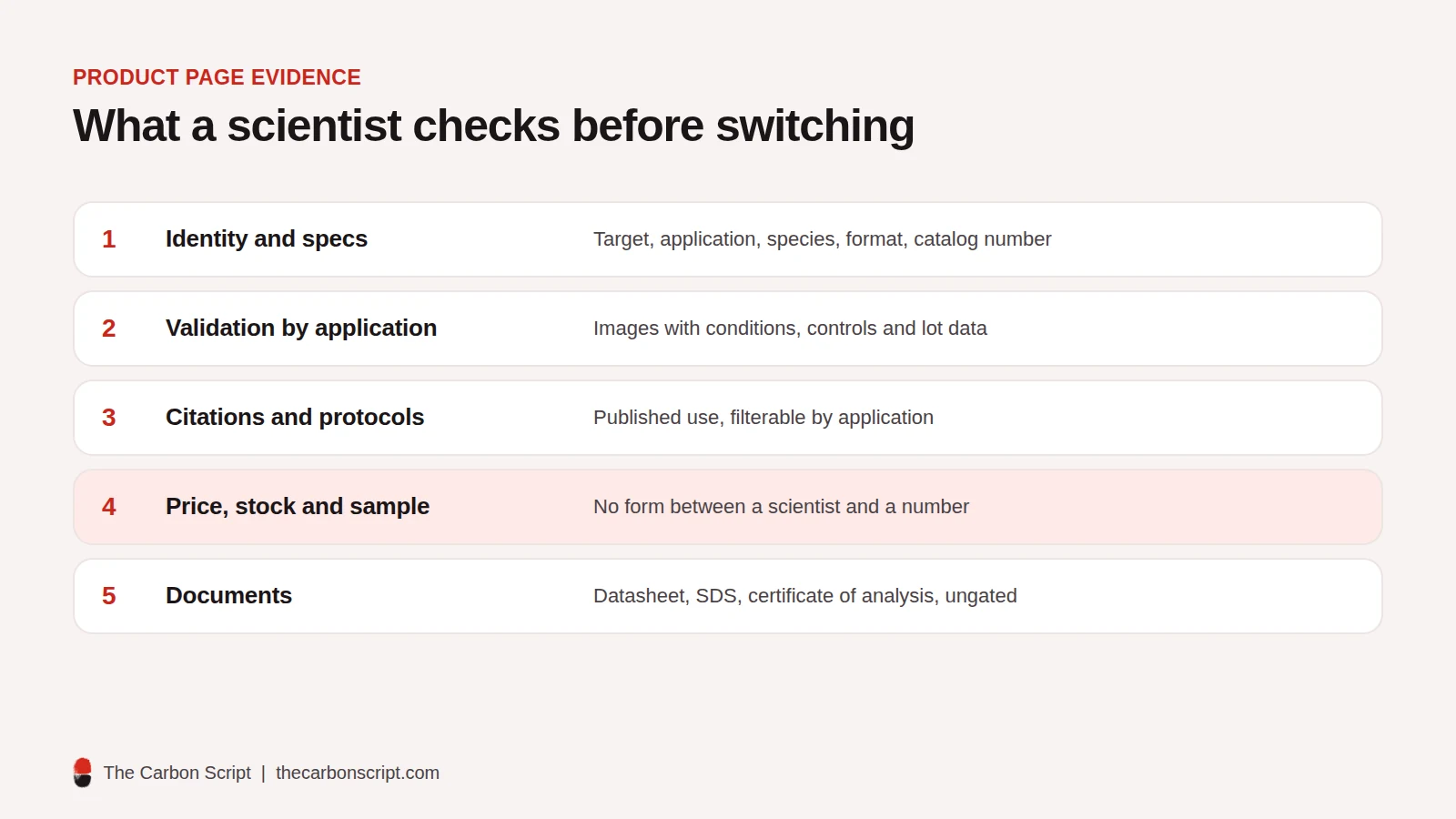
- A specific title: product name with target, application, species and format, plus the catalog number.
- Key specifications above the fold in a scannable table.
- Validation by application, each image with full conditions and controls.
- Citations and protocols, filterable by application.
- Price and availability, or an instant quote, plus a sample request. A form between a scientist and a price is a reason to check a competitor.
- Ungated documents: datasheet, safety data sheet and certificate of analysis by lot.
Do not gate datasheets and protocols. Search engines and AI assistants cannot read what sits behind a form, and scientists will not fill one in to see a dilution. Put the key data in the page itself, in HTML, and mark products up with Product structured data including the SKU, manufacturer part number and brand. Organize category pages by application and research area as well as by product type, because that is how researchers browse.
Make trying the product easy
- Samples and trial sizes remove the budget barrier for a first test.
- A performance guarantee in your validated applications, with a replacement or credit if it fails, is common among established antibody suppliers and lowers the risk of a first order.
- A side-by-side protocol that compares your product with the one the lab already uses, so the test is quick and fair.
- Application scientists who answer technical questions within a day.
- Lot reservation for long studies, so labs can buy enough of one lot to finish.
- Early-access programs for new products, in exchange for feedback and, where appropriate, application data. Disclose any support in content that comes from them.
Launching a new product line? The free pre-launch marketing checklist covers proof, product pages and the first 90 days.
Get your product cited
Citations are both proof and discovery: researchers search the literature and citation databases such as CiteAb for products other labs have used. Three steps make citations more likely and easier to track.
- Register Research Resource Identifiers (RRIDs) for antibodies, cell lines and other eligible products through the Antibody Registry and related resources. Many journals ask authors to report RRIDs, which makes your product's use searchable and unambiguous.
- Add a "how to cite this product" box to every product page with the exact supplier name, catalog number and RRID.
- Track and feature citations on product pages, grouped by application, so the next researcher sees use in their own method.
Channels that reach scientists
- Search: long-tail product and protocol queries, where intent is highest and competition from big catalogs is weakest for specialist products.
- Citation and comparison platforms: CiteAb, Biocompare and similar sites where researchers compare options.
- Distributors and lab marketplaces: complete, data-rich listings, not just a name and a price.
- Email: protocol tips, troubleshooting and new validation data for existing customers, rather than promotions.
- Webinars and conferences: technical sessions with researchers who use the product, and vendor shows at core facilities.
- LinkedIn: for industry scientists, lab managers and procurement teams.
Watch the calendar too. Grant periods and institutional budget deadlines create buying peaks in academic labs. Ask your customers when theirs fall, rather than assuming.
What to measure
- Sample requests and the share that become a first order.
- Time to reorder and repeat purchase rate, the clearest signs a product has entered a protocol.
- Citations over time, tracked by catalog number and RRID.
- Search visibility for your target and application terms.
- Distributor sell-through by product.
- Support tickets by issue, which show where your pages or protocols are unclear.
If you are a new or smaller supplier
You will not beat the large catalogs on breadth, so do not try. Win on focus: a species, an application or a hard target where the big suppliers are thin. Win on transparency: full images, published limitations and real people answering questions. Win on speed and consistency: fast shipping, quick support and tight lot-to-lot control. For a startup, those advantages have to be visible on the website from day one, which is where our life science tools marketing work usually starts. If your products are labeled for research use only, our guide to marketing RUO products covers the wording rules.
Frequently asked questions
How do scientists choose lab products?
Mostly on evidence they can check and on peer experience: validation data in their own application, citations in published papers, protocols, and recommendations from colleagues. Price and availability matter, but usually after a product has passed those tests.
How do you market a new antibody or reagent?
Publish application-specific validation data with full conditions and controls, make samples easy to get, provide a side-by-side protocol against the product labs already use, register RRIDs so use can be cited and tracked, and build product pages that match the target, application and species scientists search for.
Should we gate datasheets and protocols behind a form?
No. Scientists will not fill in a form to see a dilution, and search engines and AI assistants cannot read gated documents. Keep technical documents open and gate only genuinely extra resources, such as an in-depth guide.
How do we get our product cited in publications?
Register Research Resource Identifiers for eligible products, add a "how to cite this product" box with the supplier name, catalog number and RRID, and support researchers well enough that the product makes it into their methods.
Does email marketing work for scientists?
Yes, when it is useful: protocol tips, troubleshooting, new validation data and relevant new products for existing customers. Promotional blasts with no technical content tend to be ignored.
Who makes purchasing decisions in a research lab?
Usually a group. Students and postdocs find and test products, the principal investigator approves spending, the lab manager places orders, and procurement controls approved vendors and contracts. Core facilities make decisions for many labs at once.
Sources
- mAbs (2024): Improving the integrity and reproducibility of research that uses antibodies
- bioRxiv preprint (2026): Inadequate antibody validation places animal and human tissue samples at risk of waste
- Science and Medicine Group: 2026 Customer Loyalty and Switching, Antibodies
- CiteAb: Top 100 most cited antibodies, 2025 update
- The Antibody Registry (RRIDs for antibodies)
Product pages that don't convert?
We build product pages scientists trust: validation data, citations, protocols and a clear next step.