
Key takeaways
- Your claims set your regulatory position. Protection and growth-regulation claims can turn a biostimulant into a pesticide.
- Test every trial against a nutrient-matched control, so a fertilizer effect is not sold as a biostimulant effect.
- Report the average effect with its confidence interval, the win rate and the breakeven, not the best site.
- Word each claim no more broadly than the crop, region, years and comparison you actually tested.
To turn field trial data into biostimulant claims that hold up, decide the claim before you plant the trial, test it against a nutrient-matched control across several sites and seasons, report the average effect with its variability and the share of trials that responded, and then word the claim no more broadly than the conditions you actually tested. The wording matters as much as the data. In both the EU and the US, what you say a product does helps decide which set of rules it falls under.
Most of the biostimulant marketing problems I see start long before anyone writes copy. A company runs promising trials, finds a clear yield response at two sites out of five, and asks marketing to make it sound big. The result is a claim that a regulator, a distributor's agronomist or a skeptical grower can take apart with one question. This guide works the other way round: from the claim you want to make, back to the evidence you need, and forward to wording you can defend in front of all three.
Why the claim decides the rules
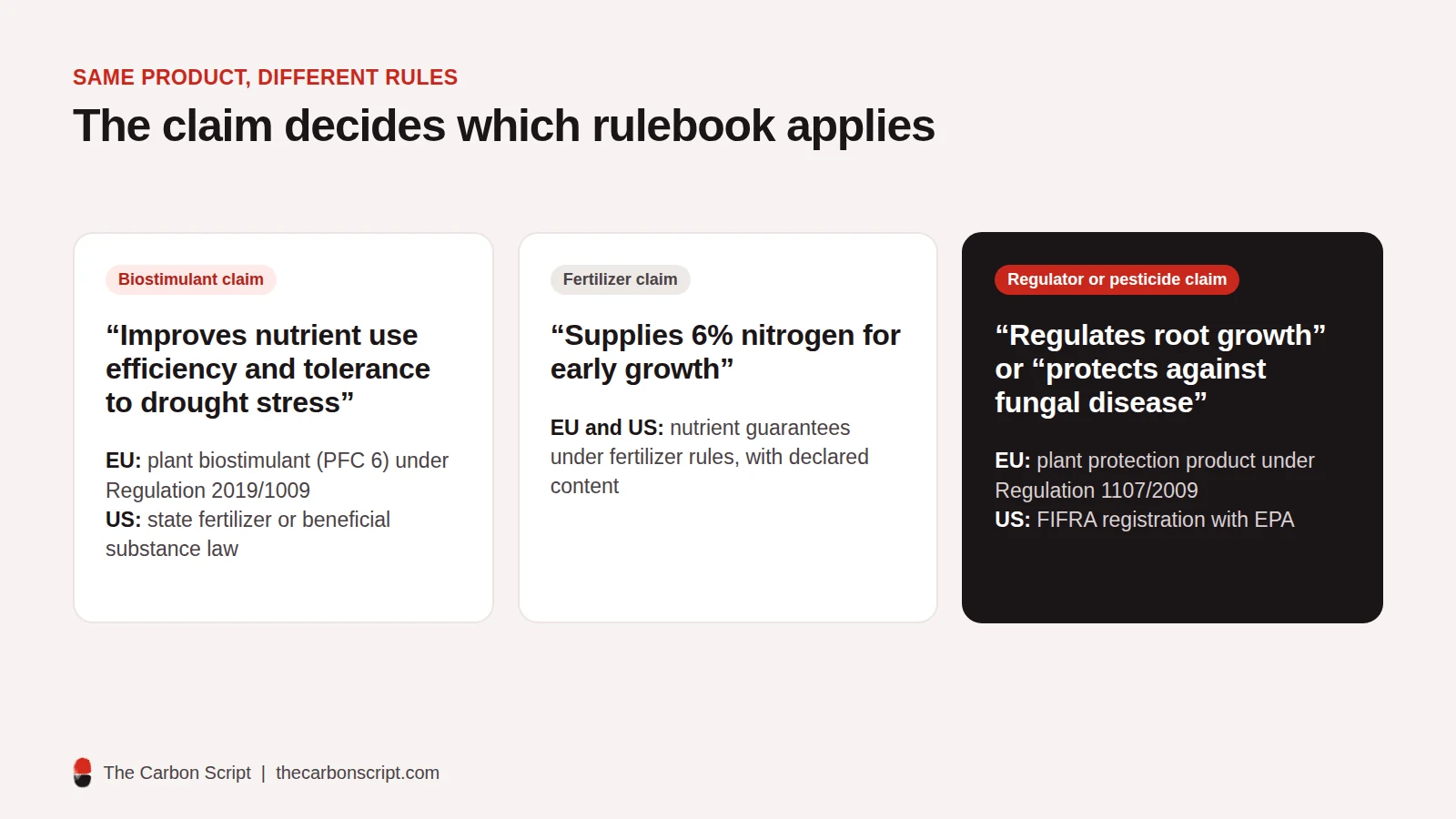
A plant biostimulant is defined by its function, so your claims are your regulatory position, not decoration on top of it.
In the EU, Regulation (EU) 2019/1009 defines a plant biostimulant as a product that stimulates plant nutrition processes independently of its own nutrient content, with the sole aim of improving one or more of four things: nutrient use efficiency, tolerance to abiotic stress, quality traits, or the availability of confined nutrients in the soil or rhizosphere. A product presented as protecting plants against pests or disease, or as influencing plant life processes in other ways, falls under the plant protection products regulation, (EC) 1107/2009, which is a far heavier approval process.
In the US, there is still no federal definition of a biostimulant in force. Under the Federal Insecticide, Fungicide, and Rodenticide Act (FIFRA), a product whose claims and composition fit the definition of a "plant regulator" is treated as a pesticide and needs EPA registration. EPA's 2019 draft guidance, which remains its most current statement on the subject, ties that decision closely to marketing claims. This is not theoretical: in 2020 EPA assessed a $300,000 penalty against two related companies for, among other things, selling unregistered pesticides with plant growth and stimulant claims.
The practical rule: claims about protecting plants from pests and disease, or about changing growth through hormonal or physiological action, are the ones most likely to be read as pesticide claims. Claims about nutrient efficiency, abiotic stress tolerance and quality, supported by data, are the territory biostimulants are meant to occupy.
The four claims, and what each one needs
The EU's four claim types are a useful framework even if you only sell in the US, because they force you to name a measurable outcome. Each has its own evidence needs and its own way of going wrong.
| Claim | What you have to show | Typical endpoints | The common trap |
|---|---|---|---|
| Nutrient use efficiency | More yield or biomass per unit of nutrient supplied, or more of the nutrient taken up | Yield at standard and reduced fertilizer rates, tissue nutrient content, agronomic efficiency | The product contains nitrogen or micronutrients and the control does not, so the "biostimulant" effect is fertilizer |
| Tolerance to abiotic stress | Better performance than the control under a stress you can prove occurred | Yield or biomass under drought, salinity, heat or cold; relative water content; recovery after stress | Running drought trials in a wet season, so there was no stress to tolerate |
| Quality traits | A measured change in a quality parameter you defined in advance | Brix, protein, size grading, color, firmness, shelf life | Measuring a dozen traits and reporting the one that happened to move |
| Availability of confined nutrients | More of a nutrient becoming available in the soil or rhizosphere, ideally with matching plant uptake | Available phosphorus or micronutrients in rhizosphere soil, linked tissue concentrations | Relying on a laboratory solubilization assay that never shows up in field soil |
For EU dossiers, the European standards body CEN has published a claims series for plant biostimulants: Part 1 sets general principles and Parts 2 to 5 cover each claim type. The 2022 technical specifications (CEN/TS 17700) were withdrawn in December 2024 and replaced by full European standards (EN 17700). If your regulatory or trial partner is still working from the 2022 documents, ask why.
Design the trial around the claim
The single most useful habit is to write the claim sentence before the protocol. "In maize under standard nitrogen, product X increases grain yield compared with a nutrient-matched control" is a testable sentence. "Product X improves crop performance" is not. Once the sentence exists, the trial becomes a test of it, and everything else follows.
Use the right controls
Every trial needs an untreated control. Biostimulant trials also need a nutrient-matched control: a treatment that supplies the same nutrients the product contains, without the active component. Because a biostimulant is defined as working independently of its nutrient content, this is the comparison that separates a biostimulant effect from a fertilizer effect. Without it, a seaweed extract carrying a little potassium can look like a biostimulant on potassium-deficient soil and like nothing anywhere else.
For nutrient use efficiency claims, add reduced-rate treatments, for example the standard fertilizer rate and a rate 20 to 30 percent lower, each with and without the product. The claim you can then test is the one growers care about: does the product let you hold yield on less fertilizer?
Replicate, randomize and spread out
- Design: randomized complete block designs with enough replicate plots per treatment to detect the effect size that matters commercially. Four replicates is a common minimum for small-plot work, but run a power calculation from your expected variability rather than defaulting to it.
- Sites and seasons: biostimulant responses depend heavily on environment. Plan several sites across the soils, climates and management systems you will sell into, over more than one season, from the start.
- Stress you can measure: for stress claims, record the stress itself, such as soil moisture, salinity or temperature, and use managed-stress sites with deficit irrigation or rain-out shelters so a wet year does not erase your evidence.
- Independence: trials run by universities, contract research organizations or facilities certified for Good Experimental Practice carry more weight with regulators, distributors and agronomists than in-house plots.
Write the analysis plan before harvest
Decide the primary endpoint, the statistical model and the rules for excluding a site, for example hail or flooding, before results come in, and store that plan with the protocol. Rules written after the data look like cherry-picking even when they are not, and an experienced agronomist will ask.
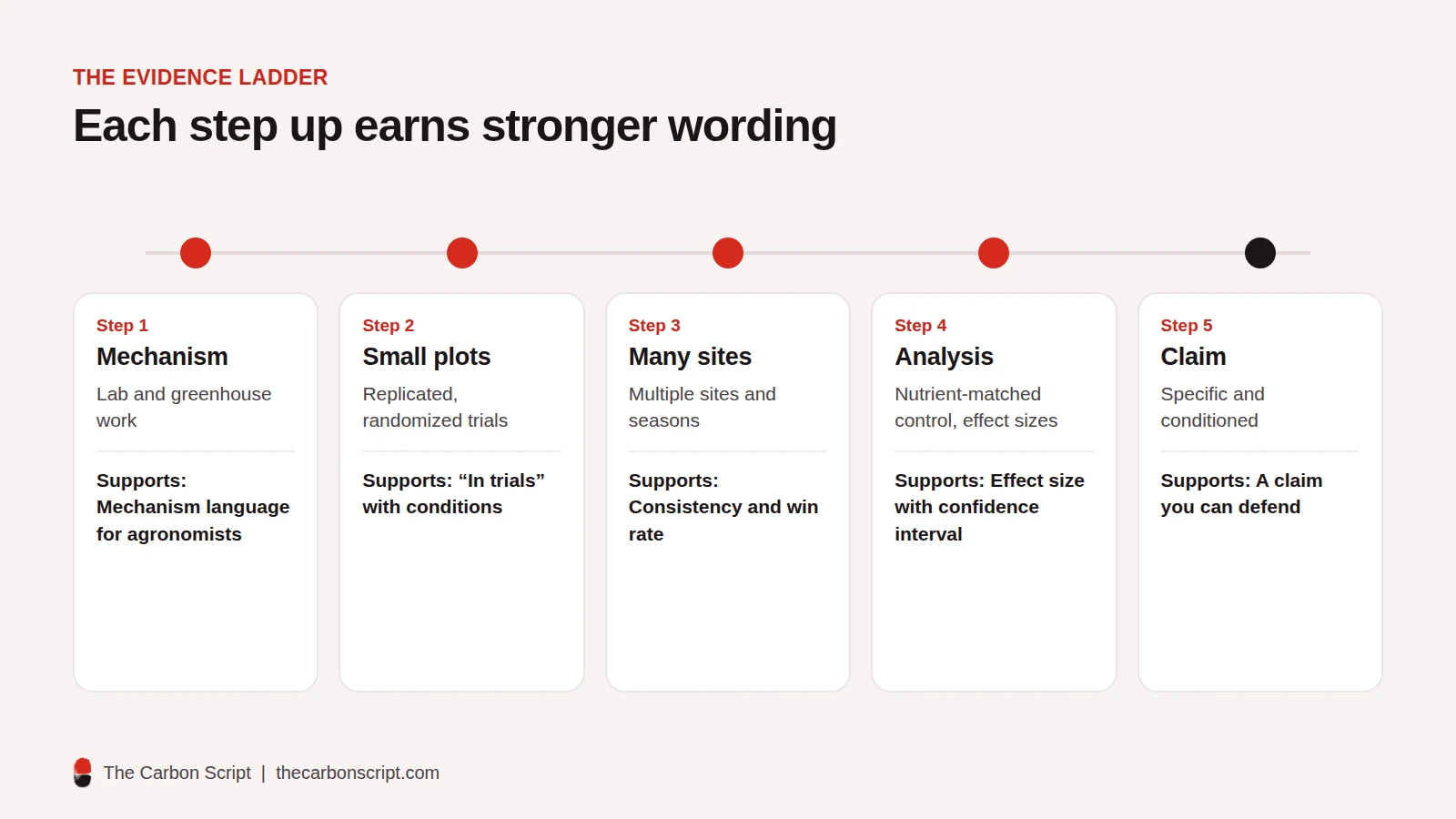
Analyze for honesty, not headlines
The way you summarize trial results decides whether a claim survives contact with an agronomist. Three habits make the difference.
Report the effect and its uncertainty
Analyze across site-years, typically with a mixed model that treats site-year as a random effect, and report the average difference from the control with a 95 percent confidence interval. A single significant site is an anecdote. A small effect that is consistent across fourteen site-years is a product.
Keep statistical and agronomic significance apart. With enough site-years, a 1 percent yield difference can be statistically significant and still not pay for the product. With few replicates, a real 4 percent effect can fail to reach significance. Both are worth knowing.
Add the win rate and the breakeven
Growers think in win rates: in how many fields would this have paid? Report the share of site-years where the treatment beat the control, alongside the average, and compare the response with the breakeven yield.
A worked example with illustrative numbers. A corn biostimulant costs $18 per acre and goes in the tank with an existing pass, and corn is priced at $4.20 per bushel. The breakeven response is 18 ÷ 4.20, or about 4.3 bushels per acre. Across 14 replicated site-years, treated plots averaged 5.1 bushels per acre more than the nutrient-matched control, with a 95 percent confidence interval of 2.0 to 8.2, and out-yielded it in 10 of 14 site-years. Only 8 of those 14 responses exceeded 4.3 bushels.
The honest summary is that the product beat the control in most fields and paid for itself on average, but would have paid in a little over half of individual fields. That sounds weaker than "boosts yield" until a distributor's agronomist runs the same numbers. Then it is the only version that keeps your credibility.
Watch for multiple comparisons
If you measure twelve independent quality traits and test each at the 5 percent level, the chance that at least one comes out "significant" by luck alone is about 46 percent. If one trait out of twelve moved, treat it as a hypothesis for the next season's primary endpoint, not as a claim.
From result to claim wording
Good claims share four ingredients: the crop, the comparison, the conditions and the size of the evidence. The examples below use illustrative numbers.
| What your data shows | Wording that invites trouble | Wording you can defend |
|---|---|---|
| Average +5.1 bu/acre in corn across 14 site-years, positive in 10 | "Boosts yield by up to 15%" | "Across 14 replicated trials in Iowa, Illinois and Nebraska in 2024 and 2025, treated corn averaged 5.1 bu/acre more than a nutrient-matched control and out-yielded it in 10 of 14 site-years." |
| More biomass in three managed water-deficit trials | "Drought-proof your crop" | "In three managed water-deficit trials, treated plants kept 12% more biomass than untreated plants under the same measured stress." |
| Phosphate solubilization in a laboratory assay | "Unlocks the phosphorus locked in your soil" | For agronomists only: "In laboratory assays, the strain solubilized tricalcium phosphate. Field trials measuring rhizosphere phosphorus are under way." |
| Brix moved in one of twelve traits measured | "Sweeter, more valuable fruit" | No claim yet. Retest Brix as the primary endpoint next season. |
Two more rules save a lot of rework. Never quote the best single site as "up to" a number; the reader assumes it is typical. And keep mechanism language, such as hormone pathways or gene expression, in technical material for agronomists, written as findings from your studies rather than as product promises. In the US, mechanism phrasing about regulating growth is exactly the kind of language that can be read as a plant regulator claim.
Free download. The pre-launch marketing checklist includes a claims review and the evidence checks to run before a product launch.
Market by market
A note on scope. This section explains how evidence and claims connect in each market. It is not legal or regulatory advice. Confirm current requirements with a regulatory specialist before you register a product or publish claims.
European Union
The Fertilising Products Regulation has applied since July 2022. It offers an EU-wide route: a CE-marked plant biostimulant can be sold across the single market once it meets the requirements for its product function category and passes conformity assessment, which for biostimulants involves a notified body. The regulation is optional harmonization, so member states can still allow products under national fertilizer rules, but those products cannot carry the CE mark or use the EU-wide route. Microbial biostimulants under the EU route are currently limited to a short list of microorganisms, so check the component material categories before you plan a European launch around a novel strain.
United Kingdom
Great Britain does not currently have a dedicated biostimulant regime. In Northern Ireland, products can be CE marked under the EU regulation, but this is not mandatory. Any product marketed as a pesticide in the UK needs a Ministerially Approved Pesticide Product (MAPP) number, so plant protection claims trigger the same problem they do elsewhere.
United States, federal
Congress has been close to a federal definition several times. The Plant Biostimulant Act was introduced in both chambers in 2025, and its language was carried into the House farm bill that passed on April 30, 2026. The Senate Agriculture Committee's farm bill, S. 5526, was reported on September 24, 2026, with its own version, which would exclude low-risk biostimulants of biological origin from the definition of a plant regulator. At the time of writing, neither has become law. Until one does, the FIFRA plant regulator test and EPA's draft guidance still govern, and your claims remain the main lever you control.
United States, states
Most biostimulants are registered state by state under fertilizer or soil amendment laws, and the states are converging on the Association of American Plant Food Control Officials (AAPFCO) Uniform Beneficial Substances Bill. California's 2024 law, SB 1522, has allowed plant biostimulant claims on labeling since January 1, 2025, supported either through an efficacy data review or through official recognition by AAPFCO. North Dakota's 2025 law requires efficacy data to support claims for beneficial substance ingredients that AAPFCO has not yet defined. Many state control officials also treat what you publish on your website and in sales material as part of the product's labeling, so claims that would never pass on the bag should not appear online either.
Elsewhere
Gulf states and most other markets register fertilizing products through national agriculture ministries, and requirements for biostimulant claims differ widely. Where rules are written down, they tend to point the same way. India's draft registration guidelines, for example, call for bio-efficacy data from replicated trials at a minimum of three agro-ecological locations. A multi-site, multi-season dataset built for the strictest market you plan to enter usually serves the others too.
Turn one dataset into marketing that works
A well-designed trial program is the most valuable marketing asset an agtech company owns. Plan the outputs when you plan the trials.
- A trial summary sheet for each crop and claim: design, sites, years, conditions, average effect with its confidence interval, win rate and breakeven.
- Regional results pages on your website, organized by crop and region and written in HTML rather than locked in PDFs, so growers, advisers, search engines and AI assistants can all read them.
- A technical bulletin for agronomists with the mechanism work, methods and full results, including the sites that did not respond and why you think so.
- A claims guide for distributors with approved phrases, phrases to avoid, and a short answer to "does it work?" that their sales staff can say with a straight face.
- A return-on-investment calculator that uses your real response distribution, not the average alone, and lets growers enter their own price and product cost.
- Demonstration strips for field days that include the nutrient-matched check, so the comparison growers see matches the one you claim.
If you already have a stack of trial reports and papers, our guide to turning a research paper into marketing content shows how one piece of evidence becomes several audience-specific assets, and our agtech marketing work starts from exactly this kind of data.
Frequently asked questions
What claims can a plant biostimulant make in the EU?
Under Regulation (EU) 2019/1009, a plant biostimulant can claim to improve nutrient use efficiency, tolerance to abiotic stress, quality traits, or the availability of confined nutrients in the soil or rhizosphere, supported by evidence. Claims about protecting plants from pests or disease fall under the plant protection products regulation instead.
How many field trials do you need to support a biostimulant claim?
EU regulation does not set a single number. The EN 17700 standards set principles for justifying claims, and regulators, distributors and agronomists expect consistent results across several sites and seasons. Some national systems are explicit; India's draft guidelines call for replicated trials at a minimum of three agro-ecological locations. Plan multiple site-years per crop and claim, and use a power calculation to set replication.
Do biostimulants need EPA registration in the US?
Only if their claims or composition bring them within FIFRA's definition of a pesticide or plant regulator. Products that avoid those claims are usually registered with each state under fertilizer, soil amendment or beneficial substance laws instead.
What is a nutrient-matched control in a biostimulant trial?
A treatment that supplies the same nutrients as the biostimulant product, at the same rate, without the active component. It shows whether a response comes from the biostimulant itself or simply from the nutrients it contains.
Is the US Plant Biostimulant Act law?
Not at the time of writing in October 2026. Its language passed the House as part of the farm bill in April 2026, and the Senate Agriculture Committee reported its own farm bill with a biostimulant provision in September 2026, but neither has been enacted. Check congress.gov for the current status.
Can I use greenhouse or laboratory data in biostimulant marketing?
Yes, as supporting evidence for mechanism, clearly labeled as laboratory or greenhouse results. Do not present it as evidence of field performance, and keep mechanism language in technical material rather than in product promises.
Sources
- Regulation (EU) 2019/1009 on EU fertilising products
- CEN/TS 17700-2:2022, Plant biostimulants, Claims (withdrawn December 2024)
- EN 17700-3:2024, Plant biostimulants, Claims, Part 3: Tolerance to abiotic stress (preview)
- Beveridge & Diamond: 2025 update on plant biostimulant regulation under FIFRA
- S. 1907, Plant Biostimulant Act of 2025
- Congressional Research Service: the 2026 farm bill, House and Senate bills compared
- Verdant Law: Senate farm bill targets FIFRA exemptions
- CDFA notice to industry: beneficial substances and plant biostimulant label claims
- North Dakota Century Code chapter 4.1-40.1: biostimulant and beneficial substance regulation
- AHDB: biostimulant product types and regulation
- BPIA and TFI: US industry guidelines on biostimulant efficacy, composition and safety
- Rural Voice: India's draft guidelines for biostimulant registration
Have trial data nobody reads?
We turn field trials into claims, pages and sales tools that growers, agronomists and regulators can all check.


